

Dear H,
Wired Magazine says, in their article One Woman’s Mission to Rewrite Nazi History on Wikipedia, that Ksenia Coffman doesn’t like glamour shots of Nazis. Russian Jews rarely do; but she kept finding too many stylish and manly Nazis on Wikipedia, and that made her mad, so for the past few years she’s on a rampage to erase them.
Not only glamour shots, though: she believes in scrubbing the personal stories and virtues of Nazis altogether — that stripping them down to their bare bones of facts and names and dates is a worthwhile cause, and that reducing them to almost nothing solidifies what she refers to as “an anti-Hitler consensus.”
Which brings us to the obvious question: what's a consensus if it has to be solidified by one woman? And if it can be, then who is the woman, and what makes her worthy of it?
Wired gives us some details about this self-appointed arbiter. They say she was born in Soviet-era Russia and doesn’t believe America is “a shining beacon of democracy” (in all fairness, I don’t either). But she adds that she “feels safe here,” and doesn’t feel like she’ll get shook-down or assaulted by cops. They say she gets obsessed with things and always finishes them; that she’s into powerlifting and fragrance collecting, and that her grandpa was in the Red Army. They say he never told war stories about it; and if he did, they weren’t as fun as the stories about Nazis on Wikipedia. Probably because the Soviets were worse*.
Wired implies more than once that she's jobless, and she also describes her editing style as “bold.” No signs of a husband or children either — confirming Paul’s observation, ex cathedra, that jobless and unmarried people tend to be meddlesome. Her only shelf of books pictured in the article implies an almost autistic obsession with World War 2 and an almost total disdain for everything else. Wired says, of her finding an outright lie about a footnote, that
She sees that her confidence in Wikipedia was “very much misplaced.” All it takes to warp historical memory, she realizes, is something this small, achievable for almost anyone with a keyboard. “So few people can have so much impact, it’s a little scary,” she says.
I agree.
Then they added, Coffman’s edits have jumped from 1,400 a month to 5,000. Still no sign of a job, apparently.
But in fairness to both her and Wired Magazine, she does raise some good questions. For instance, is “fancruft” — the embellishing of history with personal feelings and value judgments — really history? Can history be separated from the historian? And is a person’s story worth painting well because they’re good? And if a beautiful person commits a murder, can they still be beautiful? Can a bad cause negate your virtues? And is history to understand people, or to judge them? And can you do both at the same time?**
These questions aren’t for history: they’re for right now. These questions can be raised about an officer in the SS or Russell Brand or Bill Cosby. You can be both a(n alleged) rapist and a national hero, and the combination between beautiful and ugly things happens constantly, in everyone you'll ever meet. The question is, how much of the unsavory can you stand before you have to throw away the portrait? The Jews have already answered. They kept King David the murderer and Solomon the idolater. Ezra was an ethnic cleanser who split families along racial lines. Joshua and Caleb committed genocide. The Psalmist writes of his enemies, Happy is the one who seizes your infants and dashes them against the rocks. Jews decided to keep him too.
Of course the dream of Wikipedia is that there can be a history for everybody — a stripped-down bare-bones facts and dates that anyone can add to (and ideally) agree about. But this isn’t what history is. What Wired so casually describes as “fancruft” — the embellishing of names and dates with heart and soul and color and feeling — is the putting of humanity into the objective: the love of honor, the standing your ground in battle, the handsome officer in the Luftwaffe, the woman and child he’s fighting for.
And it’s exactly the humanity we fight about. When we strip the Nazis of the "fancruft” what we’re doing is saying they don’t deserve anything but names and dates — that the zeitgeist they lived and breathed and burned into whole sections of the globe isn’t worth (or safe) noting and sharing: that all they are is names and dates and horror stories: not glory, not tragedy, not beauty — not people. And it’s precisely this attitude that Nazis had for so many others. The idea that you could simply reduce any people to their bare husk of a shell, or erase them from the hearts and minds of the masses, is equally a belief of both Nazis and the Jews they tried to kill off. If you don’t believe me, try finding the Canaanite’s side of the Book of Joshua.
Thus the “fancruft” of history is the only history worth telling***: we distill the dreams and fears and tears of a whole people, or at least sections of them, and hand them on to our children. But of course, once you start down this road, you have to ask, whose dreams? And that’s why Wikipedia, as a catalogue of history, doesn’t work. The Nazi apologist or even the preserver of Nazi chronicles has his dreams and feelings and so does the vengeful and obsessive Russian Jewess. One of them believes a zeitgeist should be preserved and the other that it should be erased. And on Wikipedia it isn’t “the winners” or even “the literate” who determine history, as Wired quoted — but whichever side has the most jobless, artless, zealous middle-aged spinsters.
Yours,
-J
*Whether the Nazis or Soviets are worse is a matter of debate — the Jews prefer the Soviets and I personally prefer the Nazis. One poison tastes like rubbing alcohol and the other like a whiskey. They both burn my stomach and after ingesting too much, they make me want to throw up.
I’ll simply say here that Solzhenitsyn's Gulag Archipelago is the darkest and most disturbing book I've ever read; and that the horror stories about Jews living in Nazi Germany were about the same thing as being an average Russian under Stalin. In one country, a minority lived in terror. Under Stalin, everyone did. Bulgakov's The Master and Margarita, considered the crown jewel of modern Russian literature, was about Satan showing up in Moscow and terrorizing the public. The censors thought Satan acted too much like the Cheka, so they banned the book and it was almost never published.
Solzhenitsyn has a revealing passage about how the Soviets treated their own veterans — probably why Coffman’s grandpa never glorified the Red Army. Solzhenitsyn writes of being a POW in a German camp,
[A]mong the POW’s of many nationalities only the Soviets lived like this and died like this. None were worse off than the Soviets. Even the Poles, even the Yugoslavs, existed in far more tolerable conditions; and as for the English and the Norwegians, they were inundated by the International Red Cross with parcels from home. They didn’t even bother to line up for the German rations. Wherever there were Allied POW camps next door, their prisoners, out of kindness, threw our men handouts over the fence, and our prisoners jumped on these gifts like a pack of dogs on a bone. The Russians were carrying the whole war on their shoulders—and this was the Russian lot.
Why? Gradually, explanations came in from here and there: it turned out that the U.S.S.R. did not recognize as binding Russia’s signature to the Hague Convention on war prisoners. That meant that the U.S.S.R. accepted no obligations at all in the treatment of war prisoners and took no steps for the protection of its own soldiers who had been captured. The U.S.S.R. did not recognize the International Red Cross. The U.S.S.R. did not recognize its own soldiers of the day before: it did not intend to give them any help as POW’s.
In other words, the Soviets wanted to abuse the people of the world so badly that they refused to have the people of the world care for Soviets.
Thus the Nazis get bad press for singling out groups for extermination. The Soviets get a clear pass because they brutalized their own people almost equally. The “liberal” obsession about racism, sexism, and homophobia here takes its starkest and ugliest shape. They don’t care what people do to other people — they give them a free pass so long as they rape and ruin indiscriminately.
On the scale of political villainy, I believe the Nazis are less offensive than Confederates too. To the Nazis, at least, the crimes against humanity were intended to be short-lived. That’s why they called it The Final Solution. What the Confederates planned was a perpetual problem. Instead of eliminating a whole people wholesale, like the Jews did to the Canaanites, the Confederates planned to trade and breed and enslave them — thereby perpetuating a war crime indefinitely, like the Jews did to the Gibeonites.
The Nazi was wrong because he thought he was exterminating a virus. But the lazy Confederate, who believed in the outright inferiority of the black race, thought he was spreading it.
**I don't believe it's impossible to understand someone and judge them at the same time, but it is more difficult; and Orson Scott Card writes of understanding the enemy, and why it hurts, in Ender’s Game,
In the moment when I truly understand my enemy, understand him well enough to defeat him, then in that very moment I also love him. I think it's impossible to really understand somebody, what they want, what they believe, and not love them the way they love themselves.
Thus Ksenia Coffman equated understanding Nazis with loving them, and the person who reads Mein Kampf isn't a historian, but a “Nazi sympathizer.” He's gotten too far into the Nazi mind — which in the long run, should be the goal of studying any particular people. Thus their perspectives, their ideals, their heroics have to be swept under the rug — not because they’re so different from us, but because they’re so similar****.
Which brings me to ask: is a useful history, for building and maintaining any country, necessarily an unfair one?
And secondly, did God love the whole world not just because He’s kind, but because He knows us too well?
***Any chronicle that doesn't make you feel honor and shame and anger and pity and irony and humor is a failure.
The balance between embellishment and facts is always precarious, though — go too far in either direction and you have a complete waste of time: either a navel-gazing that fails to teach the common man, or a mass of words and numbers that leaves you feeling cold and empty.
But the first has more value than the second. With fancruft you can walk in somebody else’s shoes: a saddling of one human being with the experience of another. This is the memoir and the puff-piece and the tragedy porn oftentimes used to slander whole races. But the “objective” history, a recalling of “what actually happened” without anybody-in-particular’s perspective, without anybody-in-particular's feelings, helps only the forensic scientist. It isn’t what happened, but what’s left of what happened — a skeleton without flesh, and flesh without soul. Put facts and fancruft together and you have history. Try to make a history “for everybody” and you get a phone book.
****Most Nazi soldiers are simply written off as monsters until you read what they wrote for themselves. Guy Sajer, a half-French half-German writes, in the preface to his World War 2 memoir The Forgotten Soldier,
Guy Sajer… who are you?
My parents were country people, born some hundreds of miles apart — a distance filled with difficulties, strange complexities, jumbled frontiers, and sentiments which were equivalent but untranslatable.
I was produced by this alliance, straddling this delicate combination, with only one life to deal with its manifold problems.
I was a child, but that is without significance. The problems I had existed before I did, and I discovered them. Then there was the war, and I married it because there was nothing else when I reached the age of falling in love.
I had to shoulder a brutally heavy burden. Suddenly there were two flags for me to honor, and two lines of defense — the Siegfriend and the Maginot — and powerful external enemies. I entered the service, dreamed, and hoped. I also knew cold and fear in places never seen by Lilli Marlene.
A day came when I should have died, and after that nothing seemed very important. So I have stayed as I am, without regret, separated from the normal human condition.
And then suddenly the Nazi becomes a child, born into things beyond his control, fighting for two homelands he never chose. Sajer's descriptions of his comrades and his first love, who he met on leave and never saw again, are equally humanizing; and you begin to realize that World War 2 was a much bigger tragedy for the Germans than for us.
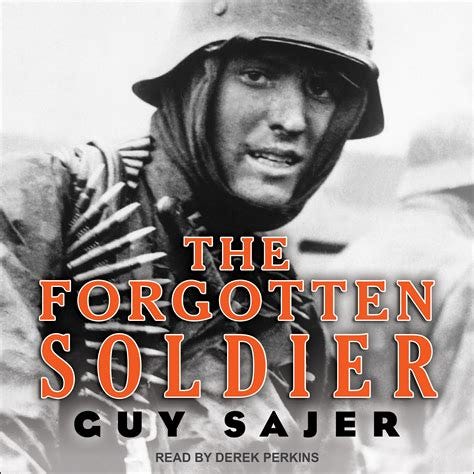
One particularly moving passage was his description of Captain Wesreidau, a man who could have been great if he was only born in another country. Sajer writes,
Our conversations with Captain Wesreidau made a deep impression on us. His obvious and passionate sincerity affected even the most hesitant, and seemed of another order than the standard appeals to our sense of sacrifice, which left us stupified and incredulous. He invited questions, which he answered with intelligence and clarity. He spent his time with us, whenever he was free from other duties. We all loved him, and felt we had a true leader, as well as a friend on whom we could count. Herr Hauptmann Wesreidau was a terror to the enemy, and a father to his men. Every time we moved, or were sent out on an operation, his steiner preceded our vehicles.
Later we get Captain Wesreidau himself speaking, as the German Army is on the verge of collapse and almost surrounded by Soviets.
We are trying, taking due account of the attitudes of society, to change the face of the world, hoping to revive the ancient virtues buried under the layers of filth bequeathed to us by our forebears. We can expect no reward for this effort. We are loathed everywhere: if we should lose tomorrow those of us still alive after so much suffering will be judged without justice. We shall be accused of an infinity of murder, as if everywhere, and at all times, men at war did not behave in the same way. Those who have an interest in putting an end to our ideals will ridicule everything we believe in. We shall be spared nothing. Even the tombs of our heroes will be destroyed, only preserving — as a gesture of respect towards the dead — a few which contain figures of doubtful heroism, who were never fully committed to our cause.
With our deaths, all the prodigies of heroism which our daily circumstances require of us, and the memory of our comrades, dead and alive, and our communion of spirits, our fears and hopes, will vanish — and our history will never be told. Future generations will speak only of an idiotic, unqualified sacrifice. Whether you wanted it or not, you are now a part of this undertaking, and nothing which follows can equal the efforts you have made, if you must sleep tomorrow under the quieter skies of the opposite camp. In that case, you will never be forgiven for having survived. You will either be rejected or preserved like a rare animal which has escaped a cataclysm. With other men, you will be as cats are to dogs and you will never have any real friends. Do you wish such an end for yourselves?
And there, in the span of two paragraphs, in the depths of enemy territory and on the verge of a massacre, he predicted the existence of Ksenia Coffman.
Personal end-note (for the idiots)
I do not support or wish to resurrect the Nazi Party. This is an essay about historical perspective and why it’s controversial — not an endorsement of genocide, or an indictment of Jews. All references to Jewish atrocities are attacks on hypocrisy — not on the Jewish people themselves as Jews. Everybody needs a good look in the mirror.
I reserve the right to judge people by their behaviors — and not solely by their labels. If you think historical villains can’t do beautiful things and historical victims are all saints, feel free to unsubscribe from this page. Each of us bears the image of God and everyone is screwed up in some way or another. I plan on treating them accordingly.
Email me at letterssubscription@gmail.com and get my free essay collection!