

Dear T,
There are a lot of picture quotes from Charles Bukowski, but the most famous of them is,
And when nobody wakes you up in the morning, and when nobody waits for you at night, and when you can do whatever you want. What do you call it, freedom or loneliness?
—not actually his, it turns out, since it apparently came from some other bum named Milan Kundera. How these quotes get mismatched so badly is anybody’s guess, like Hunter S. Thompson's
Life should not be a journey to the grave with the intention of arriving safely in a pretty and well preserved body, but rather to skid in broadside in a cloud of smoke, thoroughly used up, totally worn out, and loudly proclaiming "Wow! What a Ride!
Pictures of Hunter won’t do next to this because he took his own advice, and he ended so sadly and badly that he had to blow his own brains out. But at least he was consistent. He said it and he meant it and he lived it — and in the end he found he hated it. So we ignore this part, the most important part, and put his quote next to random old ladies riding bobsleds or doing the Can Can.
Bukowski has other quotes though, many of them just as touching as the “original” I posted above.
We're all going to die, all of us, what a circus! That alone should make us love each other but it doesn't. We are terrorized and flattened by trivialities, we are eaten up by nothing.
And this reminder to be humble,
The problem with the world is that the intelligent people are full of doubts, while the stupid ones are full of confidence.
—a testament to the Dunning-Kruger effect before Dunning and Kruger stole it from the philosophers and poets, cauterized it, sterilized it, and standardized it for the scientists.
Echoing brevity is the soul of wit, Bukowski jabs at “professional” thinkers,
An intellectual says a simple thing in a hard way. An artist says a hard thing in a simple way.
— a round Shakespeare still won by 14 words, though Buk deserves an honorable mention. And following his own advice there, he sums up the essence of infatuation: an idolatrous love that's never consummated, or satiated, or disappointing:
I loved you like a man loves a woman he never touches, only writes to, keeps little photographs of.
and this half-smart half-silly rumination on the endless, all-invasive, oftentimes invisible pressures of society*:
Can you remember who you were, before the world told you who you should be?
and this jab at the party girl and the festival wook, echoing Seneca,
Beware of those who seek constant crowds; they are nothing alone.
and probably the most hypocritical one:
People are strange: They are constantly angered by trivial things, but on a major matter like totally wasting their lives, they hardly seem to notice.
—easily the strangest of the bunch, since Charles Bukowski did indeed waste his life — at least to the majority of us who enjoy having a good time.
It was almost impossible for him to live it well. He was born to an American soldier stationed in the Weimar Republic after World War 1 — a land of heartbreak and depravity and desolation. His dad tried to hack a living rebuilding Germany after the war, but Germany was too burdened by an impossible peace treaty, and he ended up out of work in the United States. This hard life led him to beating little Bukowski frequently and mercilessly; and getting picked on in school (especially for his German accent) stressed the young boy out so much he had an extreme case of acne — the worst his doctors said they’d ever seen. Thus abused by family and schoolmates and even Mother Nature, he became a reader and a drunk. No — not even a drunk: an apostle of drunkenness.
When he left home he tried going to school but didn't care for studying and dropped out. He bounced from one lousy job to another, writing poetry, and finally gave up due to overwhelming rejection. He spent about ten years roaming around the country like a bum, going from bar to bar, and sleeping around with the weirdest women in the whole world. Charles Bukowski was really cool until the first time I saw a picture of him and one of his girlfriends.
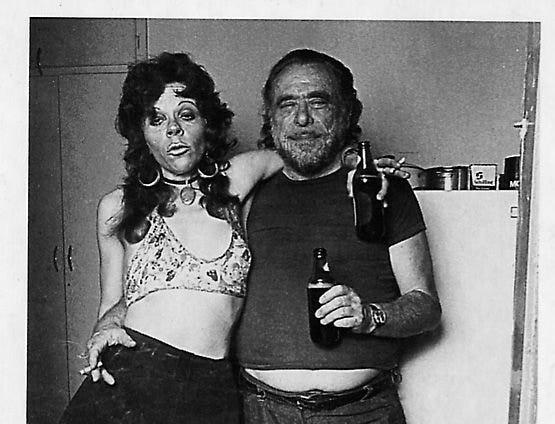
His writings about prostitutes, drunks, bad jobs and horrible families are mean, ugly, and depressing** — all based in some way on his real life, which was disgusting. The guy never had a chance, but at least we got a few nice quotes, which we pass around casually — diamonds hewed from the crags of Golgotha.
Yours,
-J
*The question of who we were “before society told you who you should be” looks like a riddle which everybody has to answer for himself. But in reality the answer is the same for everybody.
You would have been nobody.
You would have had nobody to be anything for. You could neither live up to nor embarrass anyone. You would have nobody to love, to give yourself for, or to look forward to. You would have nobody to hide from, to pretend for, or to grow old with. You would have no enemies to beat or victims to save. You would have no fools to make fun of or wise men to admire. You would have nobody to lose yourself in or anyone to get killed for — this last part which makes life worth living in the first place.
The people who say society ruins “the real us” forget that we're so interconnected with each other that we never had a chance to be anything good without them either. Every face you look into changes your face. Every soul you bump into leaves either a loving touch or a cold brush or a bruise mark. How you change for them is partially up to you, but you can only affect the direction you change — not the fact of it. The yearning to be free of society is never the dream of the winner. It’s of the man who’s been bruised and broken by it, and never had the power to rise above it.
We forget that the world that changes us is also changed by us. We feel smothered, bombarded, pushed around. We are also part of the smothering, the bombing, the pushing — the man who complains about traffic while being it. We are all living in a chain reaction of moods and actions going back millennia. Most of us don’t take it for what it is: a chance to leave our fingerprint on the universe — and for that fingerprint to be a Michaelangelo.
We forget that helping your wife do the dishes, hugging a kid and telling him he’s doing a good job, looking into a customer’s eyes and seeing them as a person, with needs and fears and dreams of their own, and smiling at them and meaning it — these little things, all in our power, make society just as much an object as a subject. We change others and are changed, and so few of us are focused on the first. Our senses tell us what’s happening all around us, and we forget that what’s all around us is also full of senses — and that every second we are being sized up, weighed, and tasted, and mimicked.
A man never knows who he is until he comes in contact with somebody else. What they bring out of him defines him — and, as he collides with thousands of other souls, some for moments and others for decades, he creates a thousand portraits of himself. Some of these portraits are are truer than others. He is half brick and mortar and half a figment of the imagination — a dream that lasts well after he leaves the home, the office, or the planet.
Thus the question is never who are you? or who am I? It’s, who are we? — and when?
**Not everyone from the trash bin thinks life itself is garbage. Nick Cave writes to a fan in The Red Hand Files,
You are right to be worried about your growing feelings of cynicism and you need to take action to protect yourself and those around you, especially your child. Cynicism is not a neutral position — and although it asks almost nothing of us, it is highly infectious and unbelievably destructive. In my view, it is the most common and easy of evils.
I know this because much of my early life was spent holding the world and the people in it in contempt. It was a position both seductive and indulgent. The truth is, I was young and had no idea what was coming down the line. I lacked the knowledge, the foresight, the self-awareness. I just didn’t know. It took a devastation to teach me the preciousness of life and the essential goodness of people. It took a devastation to reveal the precariousness of the world, of its very soul, to understand that it was crying out for help. It took a devastation to understand the idea of mortal value, and it took a devastation to find hope.
Unlike cynicism, hopefulness is hard-earned, makes demands upon us, and can often feel like the most indefensible and lonely place on Earth. Hopefulness is not a neutral position either. It is adversarial. It is the warrior emotion that can lay waste to cynicism. Each redemptive or loving act, as small as you like, Valerio, such as reading to your little boy, or showing him a thing you love, or singing him a song, or putting on his shoes, keeps the devil down in the hole. It says the world and its inhabitants have value and are worth defending. It says the world is worth believing in. In time, we come to find that it is so.
These aren’t idle words from a random musician. Aside from the fact that he went from a heroin-fueled trainwreck to Jesus Christ, he discovered people are beautiful because he fell in love and got married and fathered some boys (not exactly in that order). He saw that mankind’s existence is justified by the love between parents and children. And he realized it most clearly when his family was taken from him.
He says, in an interview with Rolling Stone,
Grief, like love, is a mess. Grief manifests as awesome and Godlike. It was not about “acceptance,” which suggests a kind of ultimate returning to business as usual, rather it is an obliterating force that requires a kind of transmutation of being, where we turn from one thing into another thing. The experience of losing my two sons was a reordering of one’s essential being. Ultimately, if we are lucky, we stop focusing on our own wounds and look to the wounds of the world.
If we are lucky is right. He began on track to become Charles Bukowski and being kicked in the face by life turned him into Mother Theresa.
***What exactly is Bukowski’s poetry like? Sad and dark and uncomfortable. Barring the filthier stuff I've read (and boy does it get disgusting), here's a solid dose — the third one being my favorite: