

Dear S,
Genesis 6 reads,
[T]he sons of God saw that the daughters of humans were beautiful, and they married any of them they chose. [...] The Nephilim were on the earth in those days — and also afterward— when the sons of God went to the daughters of humans and had children by them. They were the heroes of old, men of renown.
Clarification is needed on this subject. We applied for answers to God, to the Holy Roman Catholic Church, and Pastor Billy from First Baptist, but to no avail. We were forced out of desperation to hunt for context in the Old Testament; and in it we find that The Sons of God are mentioned in Genesis 6, the Book of Job, and possibly Psalm 82* — all references, apparently, to celestial beings.
Who these beings were (or maybe are) is unclear; but they were present at the founding of the world (Job 38:7), they are obviously a part of God's heavenly court (Job 1:6), and Satan may or may not be one of them (Job 2:1). They took a poll, and thought God did a good job making earth (for the most part). The sons of men, having a shorter-term perspective, and not being privy to insider secrets, have not always been in agreement.
Either way, Genesis 6 leaves us with one of two possibilities. According to Scripture, either the angels in heaven are all men, or the women in heaven are not hot.
The bigger question is why God allowed the possibility of sex in heaven at all — and why, despite the possibility of sex, there is either no sex in heaven, or the sex on earth is preferable. We have yet to see why God would create private parts and not provide either a shut-off switch or a sexual outlet; but this is practically how God designed us down here too. If there are any questions, please consult Matthew 5 for Christ’s definition of “adultery.” Or better yet, read Anna Karenina.
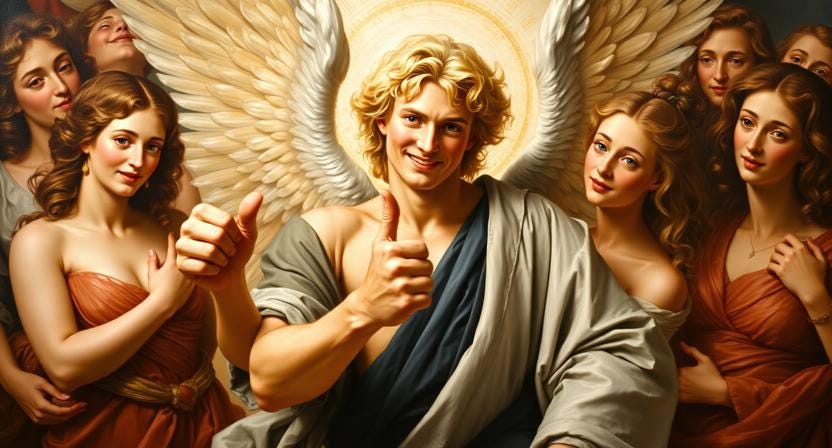
Jesus says, in response to an annoying "gotcha” question about marriage in heaven, that when we die we’ll all be "like the angels” — that is, totally free from marital vows. But this only leaves us with more questions. For instance, are vows unnecessary because we won't have gonads? Or (Sons of God in mind) are marriage vows only necessary here — because of a shortage of love, an excess of lust, and a clear dearth of resources? And will sex result in kids?
The Muslims have the clearest answer on this subject, and, for men, the most appealing. They believe heaven is women*. Proof that at least one person in Abrahamic history understood good marketing — better, at least, than whoever described heaven as “streets of gold” and “endless Hillsong.”
Either way we sincerely hope God either covers us in whoopie or castrates us. The middle ground (in this writer's opinion) belongs better on earth or in hell.
Yours,
-J
March 31st, 2026
*Michael Heiser writes about weird Bible passages in The Unseen Realm,
We all have watershed moments in life, critical turning points where, from that moment on, nothing will ever be the same. One such moment in my own life—the catalyst behind this book—came on a Sunday morning in church while I was in graduate school. I was chatting with a friend who, like me, was working on a PhD in Hebrew studies, killing a few minutes before the service started.
I don’t recall much of the conversation, though I’m sure it was something about Old Testament theology. But I’ll never forget how it ended. My friend handed me his Hebrew Bible, open to Psalm 82. He said simply, “Here, read that … look at it closely.” The first verse hit me like a bolt of lightning:
God [elohim] stands in the divine assembly; he administers judgment in the midst of the gods [elohim].
I’ve indicated the Hebrew wording that caught my eye and put my heart in my throat. The word elohim occurs twice in this short verse. Other than the covenant name, Yahweh, it’s the most common word in the Old Testament for God. And the first use of the word in this verse worked fine. But since I knew my Hebrew grammar, I saw immediately that the second instance needed to be translated as plural. There it was, plain as day: The God of the Old Testament was part of an assembly—a pantheon—of other gods.
And that's the basis of Heiser's book. In short, that even Bible scholars — like practically everyone else, I imagine — gloss over the parts of the Bible that don't fit in with their worldview. And second, that if the Bible is true, then the world is much deeper and stranger than most Americans are willing to admit. If you're curious to see how many times theology-wrecking “strange verses” pop up, I strongly recommend reading the book.
Is it really possible, though, that angel wars and pantheons are real, and we miss whole universes right in front of us? According to NPR and Priyamvada Natarajan, an astrophysicist at Yale University, the things we see comprise only about 4 or 5 percent of the known universe. And the other 95% are the things we can either detect with machines, or just exist in theory. Beyond this, we have no idea what our senses and technology and even hypotheses are missing. And these things could be flying right over our heads.
This brings me to another point. The most common objection to Near-Death Experiences (such as meeting the Being of Light) or to ayahuasca trips (such as getting enlightened by a talking snake) is that both NDEs and psychedelic trips are chemical. But I would argue that so is talking to your mom, or grilling a steak. And so is you reading this right now.
So we brush off the Book of Genesis because it’s about talking snakes, and we brush off ayahuasca snakes because not everybody sees the snake. But skepticism goes both ways — to everybody but the fake skeptic. Sure, it might be all in your head. But so are your eyeballs — and the frontal lobe you used to write off the talking snake.
As such, I believe some of us are nuts. And I believe some of our ancestors made things up. But I also believe we are inter-dimensional beings. And sometimes our chemistry determines which dimension we live in most. Whether we go insane or touch reality during an NDE is the question. And I don’t believe God wanted it to be easy for us to get an answer.
Good one. That really made me think.