

Dear M,
Money can buy you lots of things, but it can’t buy you good judgment; and if you don’t have good judgment you’ll buy silly things. This was always the problem with the parvenu. He was too gaudy to fit in with the old money.
Amazon continued this tradition by spending a billion dollars on The Rings of Power, a Tolkien-based series that has all the glitz of Lord of the Rings without much of the magic — a lot like the new Star Wars movies, and, I’m sorry to say, every single Disney movie since Inside Out.
But first the good. To begin with, this show is fun; and regarding the art direction, the billion dollars was well-spent. The Rings of Power is beautiful, and not a penny was wasted on the costumes, the special effects, and even the actors — who did better than expected, considering the controversies. Which are obvious, and as follows.
The diversity of the cast annoyed both fringes of the political spectrum, who wrote volumes on whether the cast was too diverse or not diverse enough — both silly, in the end. The right-wing’s complaints died out due to quality of the acting (and, let’s be honest here, the extreme tastefulness of the main casting decisions). So far from being a hindrance to the show, almost every black actor fit in well*, putting on a variety of dialects and styles, and acting so naturally that you could almost believe they spoke and acted like Hobbits or Dwarves or Elves in real life. This is no small feat, at least to me, but this is what actors live for and pride themselves in — being like people they aren’t: a trend which “minorities” are encouraged to pursue, and those belonging to the “majority” are publicly shamed for.
Still, private talent aside, there are obstacles in appealing to liberal standards (and ideals aside, to their awards ceremonies). First and foremost is a suspension of disbelief required to take the show seriously. Aside from the fact that different races exist in small, isolated, ancient communities (where do the black Hobbits and Dwarves come from?), there’s the question of why Galadriel, a tall, skinny, fair-skinned princess-type, is the best fighter the Elves have to offer. Or why, after living for hundreds of years, her sense of strategy and tact borders on the autistic. We know that this kind of woman, who completely misjudges women’s strengths and always thinks she’s right and beats everyone over the head, exists in modern life. But in a Tolkien world, this is too much.
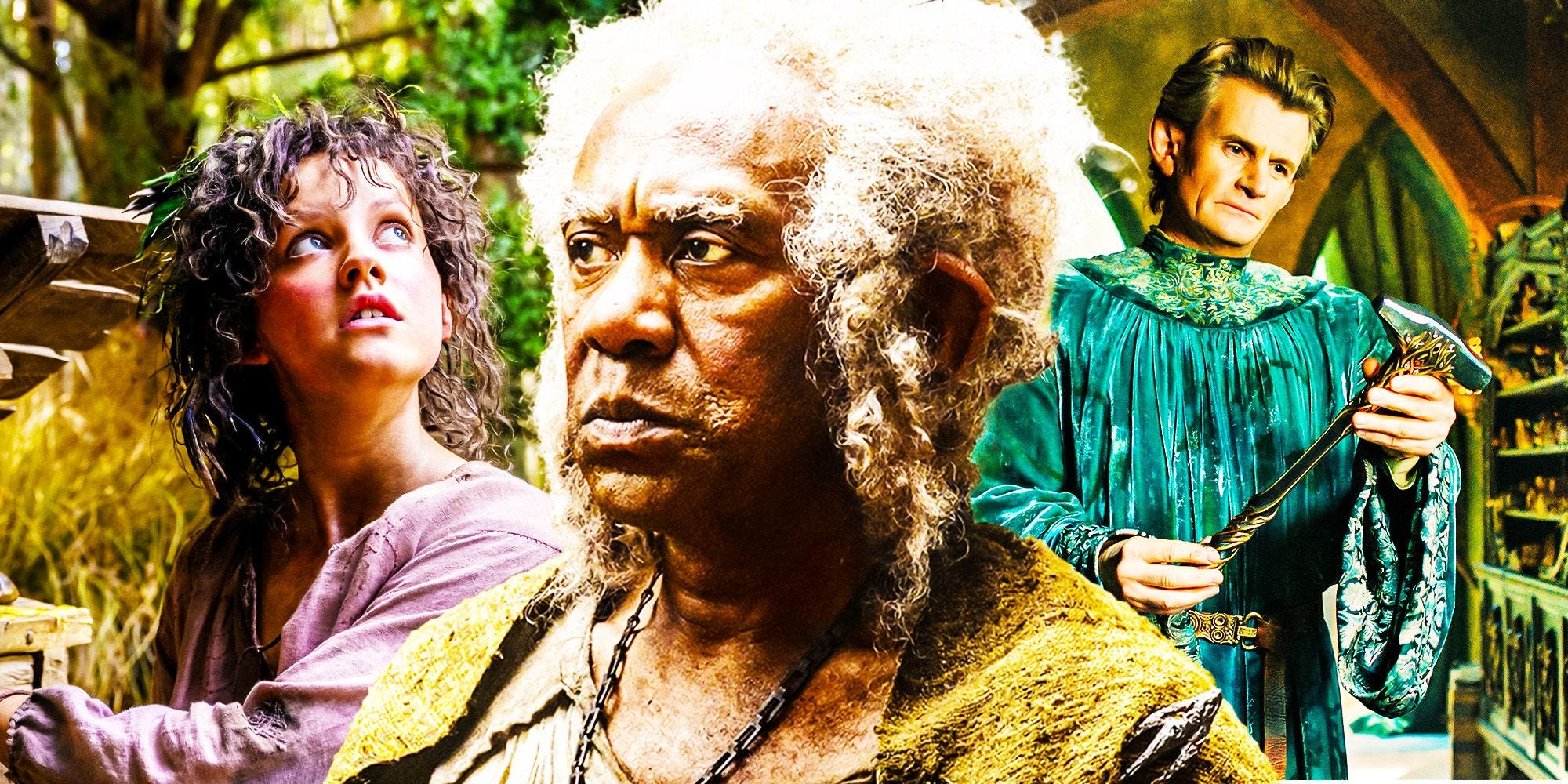
Am I the problem here? This is of course a fantasy series, and the object of fantasy is to fantasize — to create worlds and even characters which would otherwise be impossible. But Peter Jackson’s Lord of the Rings left the impossible to magic; and when magic was unavailable, to the murky world of economics. Those of us who wondered where large cities high in the mountains got their food could comfort ourselves in the idea that the people there “found a way,” — not too much of a stretch, after all, when half of all Americans believe the president controls the price of gas, and that raising taxes on the landlord makes renting more affordable. A different problem from “why doesn’t this black kid in a white village think his dad is the black elf?” Or, "how did that skinny lady beat up all the queen's guards?” Or, “how did all these women and ‘people of color’ end up ruling so many white medieval societies?”
George R.R. Martin, probably the king of high fantasy, solved all these problems by making his world like our own. There was diversity in the cast because there was diversity in the nations. Brienne of Tarth was a knight because she was too big (and too ugly) to fit in as a lady. Tywin Lannister had a dwarf son because of a deformity. No snow-white king in Game of Thrones had a black daughter like queen regent Miriel. To take issue with Rings of Power’s representation is to side with the “racists,” ostensibly — but what do you call someone who takes issue with impossibility? Is collusion between good writers and reality-denying leftists itself impossible?
To this last question I would say yes, and that an inability to portray people accurately, even in a fantasy series, is why “political people” are so bad at art in general. Simply put, there’s a way things are and a way things “ought to be,” and the idealist’s inability to stop putting his ideals into situations makes them look fabricated.
Why is this a problem? Because in the end, all good art — every good song, every good poem, every good play — has to unlock something that’s already true inside us. That’s how a good show makes us feel like we’re there. Every unnatural line, every unlikely behavior, every obviously forced ideal, shatters the illusion that what we’re seeing is real — that we might be there in the Dwarf mines, or in an ancient village. You can tinker with the setting itself. You can put us in space or underwater or in a wizard’s tower. But you tinker with the people too much, you make them too unlike the people you know, too credulous, too high-minded, too corny, too Christian or liberal or even too witty, and suddenly the story loses its appeal. It no longer puts us into another world because it fails to get into ours*.
I said earlier that money can’t buy you good judgment, and, unfortunately, bad judgment bleeds into other areas of life too. Thus even though the show is fun, much of its dialogue is contrived and old-fashioned without feeling real; many of the jokes are stale, and overall, despite a billion dollars, it still feels like a TV show. It also (despite its use of The Walking Dead’s Bear McCreary) lacks a moving soundtrack — crucial not only to the development of mood, but especially to the branding of a series.
Thus it’s the polar opposite of Peter Jackson’s trilogy. With Jackson the CGI aged a bit; but the heart of it, the arrow whizzing past Elrond’s ear without him flinching, the love and loyalty of Samwise Gamgee, the temptation of Boromir and the believable, inspiring manliness of Viggo Mortenson’s Aragorn, are all going to be passed on to our grandchildren. Probably more often than the actual books. With Rings of Power we love the glitz, of course; but I predict that in 20 years, the heart of it — the heart which keeps Indiana Jones and Tolstoy and the Bible alive — will look dated.
Yours,
-J
*The opposite error is from the “slice of life” camp — the people who make their writing so ordinary that instead of making you roll your eyes you want to close them. The idealist and the corn-dog can make you laugh with their bad writing. The “realist” makes you mad that you watched his show instead of just living.
And what about poetry, or farce? Wilde’s The Importance of Being Earnest is all wit — and the wit takes the front seat to the story. Nobody talks like Shakespeare’s Macbeth — but poetry is about unlocking images and feelings, not about being true to speech. There's no office like The Office — but it takes the things we do (or aren't supposed to do) and blows them out of proportion to get us to laugh. And maybe you can do all these in a single novel. But Rings of Power isn’t any one of these, and the writers’ inability to recognize Tolkien’s universe for what it is — a vehicle for a serious, thoughtful piece of fantasy — is its downfall.