

Dear S,
Trump’s promise that, if Republicans win the midterms, he’ll send $5,000 to every adult citizen, is a novel idea in only one area — that we call it a bribe. So far it is just like all the other checks he’s promised to send us: a $2000 tariff dividend, and a DOGE dividend, and $9000 for stay-at-home moms. But is this materially different from promising to extend Medicaid, or to cut taxes while increasing the debt, or to lower the price of gas? I would say no — except insofar as it pretends to benefit all Americans, which we say is crazy and unaffordable. Americans will only go bankrupt, we say, if it pays the poorest of us, the richest of us, or the most of everyone else. We can promise free aid to around 175 countries (go ahead, look it up!), but if we promise to send aid to all Americans, it presents “significant moral and legal hurdles.”
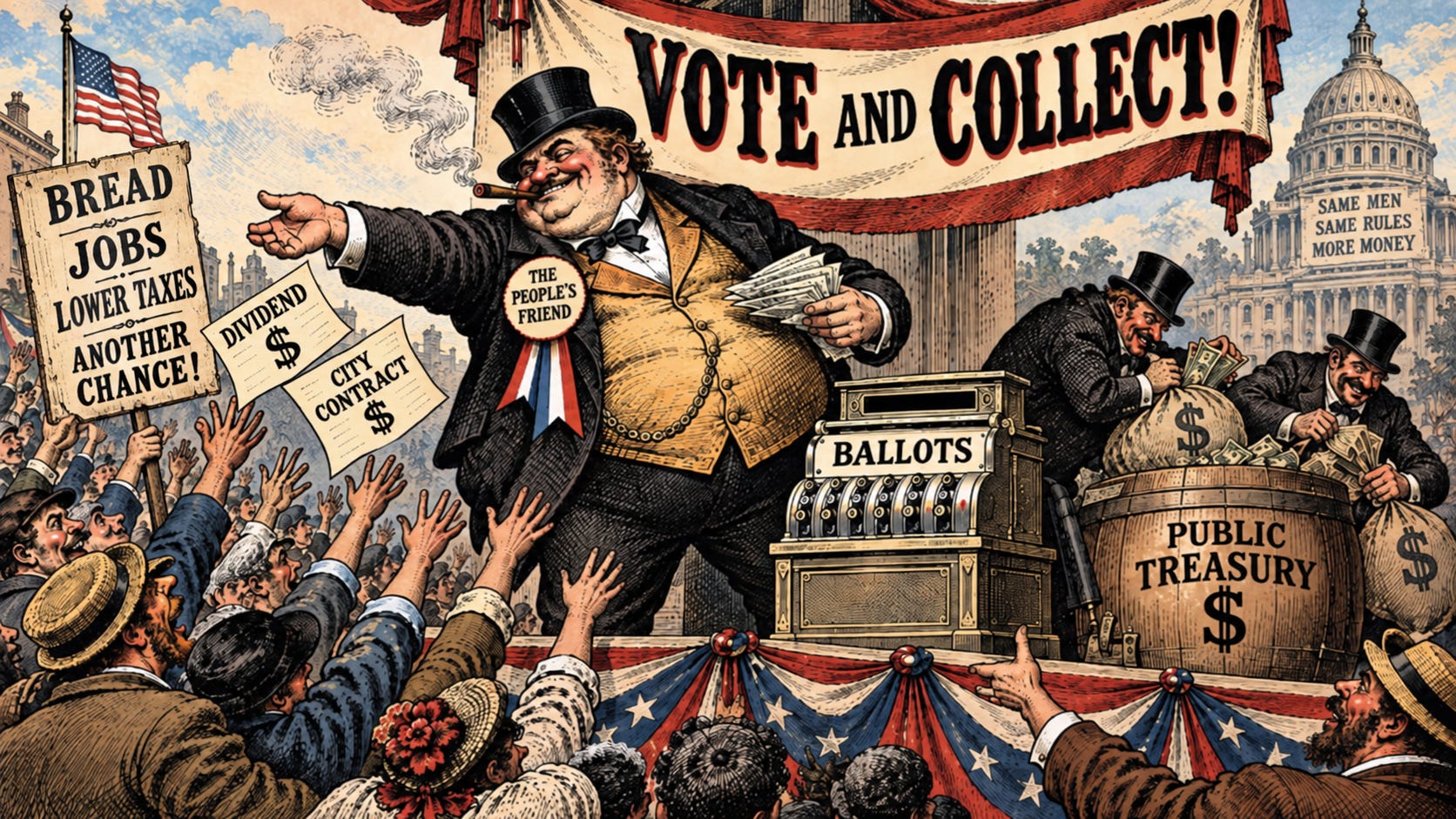
This is, of course, beyond the significant economic hurdles. The idea that the government can pay everyone is hampered by the idea that someone out there can be squeezed for it — an illusion that vanishes once the people getting paid are the same people getting looted. But this of course was always an illusion too. And so was the idea that most of politics these days isn’t bribing anyway. The real issue isn’t that somebody (or everybody) is getting paid: it’s the illusion that everyone isn’t going broke, and that Americans haven’t been morally bankrupt for decades and easily bought. We have lost the moral high ground that voting is “in the best interests of the country” — and the pissing contest that is election season is now happening right onto our feet.
Below I had some other thoughts — equally uncomfortable, but equally pressing.
Yours,
-J
September 22nd, 2026
1. Liberality and cowardice.
In Singapore, a country without a serious drug problem, the penalty for smuggling serious drugs into the country is death. Over the past five years they have executed around 35 people, mostly for drug offenses.
In the United States, the penalty for smuggling drugs into the country, at absolute worst, is life. Over the past five years, roughly 470,000 people have died from drug overdoses — not to exclude the millions who crash under the influence, who blow up their families and careers, or end up in jail, or on the streets, or fall prey to pimps.
The difference in policy is clear. Singapore has chosen to kill the dealers. We have chosen to let the dealers kill off our friends and family.
2. In Memoriam
An old man is someone who carries a dead universe inside his head — and he holds it more tightly than the universe in front of him.
3. Salt and pepper.
A handsome young buck and a silver fox.
With the first, women want him to make their baby. The second has an additional advantage: men are more likely to listen to what he says, and they want him to run their company. Both are forms of falling in love.
4. Mixed feelings.
In Genesis 8:21, God is reported to say that every inclination of the human heart is evil from childhood.
We are unsure here whether to cry because we’re a mess or cheer because nobody is clean. We never stood a chance in hell, so God decided to give our hell a chance.
Here we see ourselves drowning — and we can breathe easier. The impossibility of swimming means the necessity of a rescue.
5. Outlast and Endure.
You can’t expect a dog to mature, but as it gets older you can at least expect it to get tired.
The same goes for many people. We never outgrew some of our vices. Many times they simply outlasted us.
6. Return of the Shaman.
Therapy is a profession because most people’s theories about themselves are either nonexistent or false. Does therapy correct these? Not necessarily — many times it merely invents new ones.
The ancient man told tales about the beginnings of the world. The modern man needs myths about the origins of his own feelings. We have charted the whole planet only to find the biggest mystery was always us.
7. Good Company.
What is fellowship? A journey in company that feels like home.
It can’t be fellowship if “company” means tiptoeing around the interesting and the serious. If a tent is too big, it loses the feeling of home and feels more like a circus.
8. Somebody’s devil.
A wise man can get along with many kinds of people, but only a coward can be a saint in everyone’s eyes. A really good and effective man is a villain to somebody.
9. The great dilemma.
If you say cut that shit out your kids think you’re a brute.
If you say cut that crud out your kids think you’re a weenie.
10. Commandment or riddle?
In Matthew 22, Jesus is asked what the greatest commandment is and proceeds to give an answer everybody pretends to like. He tells us to Love the Lord with all your heart, mind, soul, and strength, and to love your neighbor as yourself.
In other words, 1) that in a universe of constant change, we are to live with an overriding singularity of purpose. And 2) to stop acting self-centered, subjective, and desperately clawing at the universe for life and happiness — in other words, to stop acting like a biological organism.
What He gave was an impossible answer to an impossible question. As if the demands and sallies of life — coming at us from all directions, each demanding their own unique blocks and dodges and parries — could be whittled down to two thoughts. As if the concept of being separate from everything else could be reversed.
Is this really a commandment? Or is it a riddle?
11. Crowns and ballot boxes.
The Buddhist guru Alan Watts once said that God was a king because He was invented in the age of monarchy. He said we needed a new concept of God because now we live in an age of democracy.
The problem with the age of democracy is an overvaluing of the common man and the undervaluing of our superiors: you don’t know that sometimes someone is so far above you in every way that you ought to make Him your king.
12. A warning.
To be “too wise” is tot throw away the rules. To become “too good” is to throw away your brains. One disregards the bridle and gets the spurs. The other is riderless and wearing blinders and doesn’t know when to turn. Real wisdom is holding the rules tight — and in the strange and occasional moments, knowing when to throw them away
13. Problem/solution.
When a man hurts physically, he knows what hurts, and many times why.
When a man hurts spiritually, all he knows is that he hurts — and he may hide even that. What he needs to throw away, he wants to keep. What he needs for a cure, he thinks he hates. He confuses poison for medicine, and medicine for poison.
14. Elephant in the room.
A question for Christians.
If Moses’ Law is good, why don’t you implement it?
If Moses’ Law is bad, why do you follow God?