

Dear H,
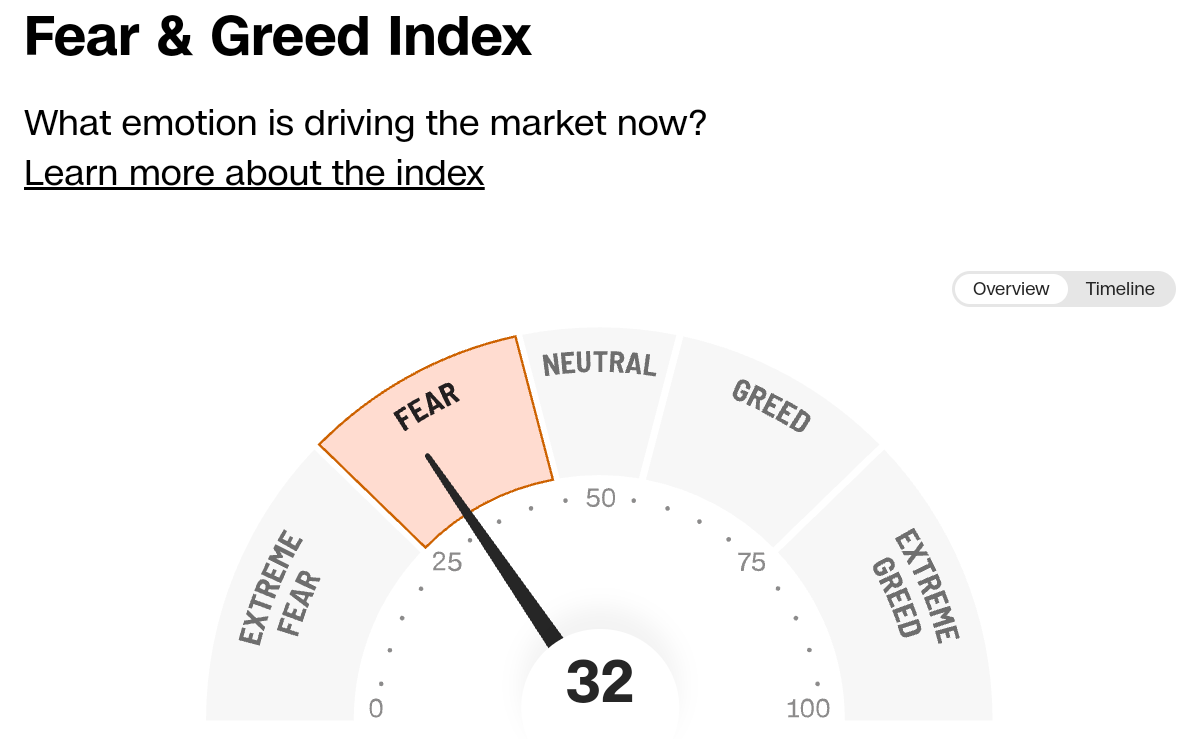
This morning I woke up and discovered CNN Business's new Fear & Greed Index: a rating of 0 being “extreme fear,” and a rating of 100 being “extreme greed.” At the moment I’m writing this, they say we’re at 32.
What is the Fear and Greed Index, you ask? According to CNN,
The Fear & Greed Index is a way to gauge stock market movements and whether stocks are fairly priced. The theory is based on the logic that excessive fear tends to drive down share prices, and too much greed tends to have the opposite effect.
In other words if you want to sell too many stocks you're a coward, and if you're buying too many stocks you're a jerk. A “fairly priced” stock, we can safely deduce, is a stock nobody really wants to buy or get rid of; and a “healthy” market is one where nobody wants to trade anything at all.
An important question might be asked here. Isn’t the whole gist of the stock market to buy low and sell high? And how do they determine whether people are buying too high or selling too low? Especially since you can’t buy without a seller?
Stock prices can only plunge when people want to get rid of something, of course, and fewer people want to buy it than yesterday. But no matter how high or low prices go, no matter how many sales happen in one day, every act of “fear” would have to be counterbalanced by an act of “greed.” One person's afraid the stock could go lower, and the other person's hopeful he can sell it for higher. In other words, just like every transaction in the history of the whole stock market.
The label of "fear” is understandable — even fair. It’s the concept of “greed” that breaks out the clown shoes. Is greed when you want to earn a lot of money? If so, how much exactly*? Is it when you want to earn money for yourself and not give it away for free? Is it when you earn at the expense of a relationship, or of justice? Is greed when somebody’s hurting and you keep your money so you can have fun? Are you unselfish when you earn nothing? And if so, is any investment moral at all?
CNN does provide some insight to their method, though, and thankfully they have a Q&A further down the page.
How is Fear & Greed Calculated?
The Fear & Greed Index is a compilation of seven different indicators that measure some aspect of stock market behavior. They are market momentum, stock price strength, stock price breadth, put and call options, junk bond demand, market volatility, and safe haven demand. The index tracks how much these individual indicators deviate from their averages compared to how much they normally diverge. The index gives each indicator equal weighting in calculating a score from 0 to 100, with 100 representing maximum greediness and 0 signaling maximum fear.
In other words, the difference between "greedy” and “normal” is based on 1) how fast prices are changing, 2) how fast prices are changing (hello again), 3) whether (you guessed it) prices are changing, 4) how much people are allowed to buy or sell for, 5) whether people are feeling lucky playing hot potato, 6) (can you believe it) how much prices are changing, and 7) whether people don't want to play hot potato anymore. I looked up every single one of these terms on Investopedia, and what CNN is trying to say, in so many fancy words, is that they're just reading you the NASDAQ**.
But just in case CNN hasn’t made it completely clear they think you’re stupid, they have a handy guide at the end to drive the point home. They add,
How to use Fear & Greed Index?
The Fear & Greed Index is used to gauge the mood of the market. Many investors are emotional and reactionary, and fear and greed sentiment indicators can alert investors to their own emotions and biases that can influence their decisions.
So if you don’t know how you’re feeling, and you’re worried you might accidentally sell a stock because you’re a chicken, or you might buy one because you’re an asshole, go ahead — look up CNN’s FAG Index and they’ll give you a rating. Today you’re 32, and you're kind of a coward. But at least we can say you're not a jerk.
Yours,
-J
P.S. I always appreciate a good acronym, but few are better than Seattle's South Lake Union Trolley, which they accurately named until somebody — most likely a professor of communication at the University of Washington — discovered it could be shortened to S.L.U.T.
Overnight the printing industry went nuts, and we were seeing posters, t-shirts, and stickers saying “RIDE THE S.L.U.T.” in every coffee shop and tchochke hut. Unfortunately the city council lacked a sense of humor, and they renamed it the South Lake Union Streetcar: proof that you can let junkies poop on the streets and still find skanks a disgrace.
Other acronyms have been equally embarrassing. The Moro Islamic Liberation Front turned out to be MILF — which is the only reason anyone's ever heard of them, poor bastards. The Senior Housing Assistance Group is SHAG, which somehow makes invalids grosser than they already are. The Food Assistance Program for a while was FAP; and the American Forces Radio and TV Services — since rebranded the American Forces Network — was for decades known as AFRTS. Not entirely inaccurate, as their programming usually stunk.
**If you love the things money can buy, you can be happy. You can kick back and look at a nice yard, or wax and polish a car, or watch a show on a new couch. But nobody who loves money can ever have enough.
***The pricing of things in money is one of the greatest miracles we ever stumbled into by accident.
Prices tell businessmen what the public wants and doesn’t want without the public having to say it. It tells him when there’s a glut or a shortage without him having to know it. When forest fires burn up all the lumber in Washington, people will feel it in New Jersey. When people pay more in New Jersey, the lumber mills pick up production in Montana. When people cut too many trees in Montana, prices drop too low in Valdosta. It’s the closest thing we’ve ever had to psychic powers, and any attempt to tamper with it — calling it “fear” or “greed” and shaming people, for instance — is (in the long run) counterproductive. Even if they’re panicked. Even if they're greedy.
Why? Because balance is always the natural goal of pricing. Equality across the nation is the general trajectory. Fear of loss and sheer opportunity aren’t sicknesses to be warned about. They are the warning — and in the end, they’re the only workable remedies.