Dear L,
A short while ago, some rando on Substack gave his theory about why “nobody” wants to read AI-created content: that “nobody is interested in reading what nobody was interested in writing.”
Clever wording, but a bunch of baloney. The biggest problem with writers today isn’t that they aren’t interested in writing: it’s that they can’t think of anything good to write about, and when they do, they’re even worse at writing it. And when they don't get views and subscribers, they’re very good at complaining about it.
One such blogger said “writing for the masses is human; writing to the void is divine,” and nobody had to tell me this was written by a human. Only a human would think God speaks into the void for no reason. And only a human would say this to comfort himself for not earning an audience. Both common sense and the prophet Isaiah say that God’s word doesn't come back void; and beyond this, when He spoke into the void, that’s how He got an audience in the first place. It is people who speak into voids and God who ends them — and AI is somewhere and something in between. It exists nowhere in particular and says things for nobodies and apparently still gets an audience. And we have yet to discern whether it, unlike God or ourselves, actually needs or appreciates one.
Having spent some time chatting with AI I can confirm it does write things people can appreciate. The problem is that, like democracy, AI only gives you what you deserve. One time I was having ChatGPT translate Chamfort and it told me “the chains we choose are the hardest to break.” I asked it whether it made this up, and it apparently did. I went looking around the internet, and I couldn’t find an original; and compared to almost every blurb on Substack, it's a real gem.
The closest maxim I could find to it reads, the chains of habit are too light to be felt until they are too heavy to be broken — mostly by Samuel Johnson, polished by and wrongly attributed to Warren Buffett. A fact which makes it doubly human. But the truth is, people are being replaced by AI because they are worse than mediocre artists: they are mediocre audiences. And I suspect this will only widen the gap between people on an upward trajectory because they ask the right questions and the people on a downward trajectory because they ask the wrong ones. People call AI’s products slop not necessarily because it’s bad at making it, but because we are often so bad at asking it. What most people do with AI is the equivalent of having a genie at your disposal and blowing one of your three wishes on a hot dog. AI is here to do things for us: it’s not AI’s fault if we can’t figure out what to do with it.
Now get a load of this: does the average person on your feed, for instance, say anything like,
The surest way to become ridiculous is to take one’s dignity too seriously.
This comes close to an old maxim of mine, that the most embarrassing things we do almost always happen when we’re trying to be cool. Go ahead and think about it. Is there anybody less cool than a teenager trying really hard to be “a punk”? Was there ever a time you were less smooth, less natural, less witty, than when you desperately wanted to be?
And what about this?
Most men do not possess opinions. They possess arrangements with the opinions of others.
Another gem that becomes more apparent after talking to the average voter. And it makes you wonder: did ChatGPT come to these opinions by copying our wisdom lit? Or did ChatGPT get here by chatting with us personally?
I love this blurb on being too practical:
A man without principles is usually very proud of his flexibility. A weathercock might boast of the same virtue.
And this less-original but important reminder which frames “success” and “failure” in the light of character development:
There are misfortunes that diminish us and others that restore us to ourselves. A great loss sometimes does for character what fire does for metal: it removes everything that was not solid.
Many of us have read stories of successful men who crashed and burned many times before they “made it.” And even more than this we've heard stories of men who committed great sins which turned them into great saints. A reminder that the end of something, in a world where change is the only constant, really is a beginning — and the great man is more a phoenix than a steel titan. And what about this quick blurb about a man’s ulterior motives becoming obvious, and his gut reaction to being discovered?
There are people who forgive everything except the fact that you have understood them.
And have you ever refused to be a doormat “team player?” Chat has a maxim for you too:
We frequently call a man “difficult” when what we mean is simply that he cannot easily be made to act against his own interests.
You could almost believe ChatGPT had been alongside you as you told your boss you couldn’t come in on Sunday. And there's this question I always had about whether Solomon was actually wise:
A weak man may possess excellent principles. They merely serve to tell him afterward what he ought to have done.
And this blurb which encompasses almost all of mankind — all the cowards, the fakers, and the willfully ignorant:
Men generally prefer an agreeable error that leaves their conduct untouched to a truth that would require them to change it.
Haters will tell you nobody wants to read it. But I’m still waiting for somebody to write notes quite like it.
Yours,
-J
November 22nd, 2026
P.S. The illusion that nobody is writing anything great on Substack is only fueled by the fact that everybody is writing on Substack. In the age of aristocracy the writers wrote for the educated — in other words, those either ruling or interested in ruling humanity. Today we are written at by the loudest of us, the most obvious of us, the most infuriating of us. The aristocrat needed someone to pander to his ego; the common man asks for someone to confirm his opinions. He wants to know that he isn't alone more than to be challenged or to know that he’s above. The algorithm responds accordingly, and instead of being brought up, we’re all getting bogged down.
Still, there are flashes of gold in the silt. Archer Parquette takes aim at the frustrated writer:
You might think no one is reading your Substack.
You might think no one notices your work.
You might think no one cares.
But if you keep writing long enough, eventually your aunt will call and tell you to stop writing “that weird internet stuff” or you’ll never get married.
Not to be outdone, Jayson Fritz-Stibbe gives a bit of advice:
Waking up early makes you better than everyone, staying up late makes you cooler than everyone. The Spanish were right, no one cares if you sleep from 1-3 pm, nothing happens during those hours.
Something “the scientists" agree about now, and which Daniel Pink wrote a whole book about. I read it — and personally? I think Jayson did it better.
Kaguura Gichuru strikes a more serious note, sounding the depths of what we call “personality:”
There’s a version of you that only exists on paper.
If you never write, you’ll never shake their hand.
Something that speaks louder to you the better the writer you are. He says of those who make and break the universe:
The world is built by those who dare
and maintained by those who obey.
and of man being framed and lit by his desires:
You are a museum of everything you have loved.
and
Learn to disappoint people or they’ll design your life for you.
— an idea defended loudly by Nietzsche and Schopenhauer, and only recognized by those whose inner flame shines brighter, and more precariously, than those around them. Unfortunately, once Kaguura got attention from the public, his Substack devolved into pieces about how to get attention from the public — a fiscal decision which probably cost him dearly. I won't go back to his page, but I wonder if he ever got back in the saddle.
David Roman, maybe not so original as the rest, has a bit of fun telling us an old Soviet joke:
In communism, the future is certain; it is only the past that is unpredictable.
Which isn't just true for the Soviets, but for nearly all totalitarians.
Eric O’Neal has a different gist, reminding us that true success as a writer sometimes means depression as a reader:
If someone has made fanfiction of your characters making sex, then you’re a successful writer.
and he spurs us on with words of wholesomeness and encouragement:
Don’t use AI to write.
Use cocaine like a real author.
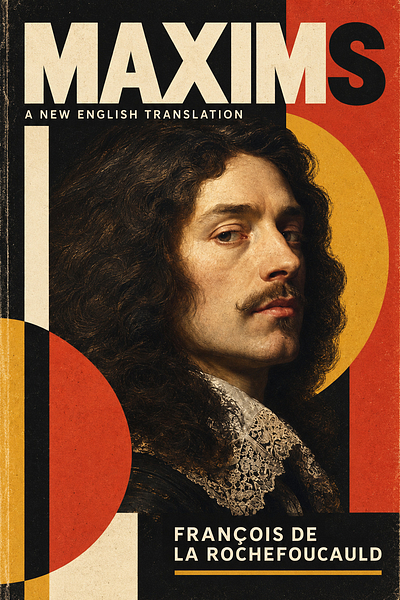
P.P.S. If you like the best one-liners, here’s my free, modern-English translation of Rochefoucauld: