

Dear M,
I wanted to write you something all month, but business and chemistry and biology got the best of me. I salvaged a little from this shipwreck — and I hope someday you enjoy it.
Yours,
-J
“Keep out!”
We are born for certain climates, like mangos for the tropics and pine trees for the Rockies. A society is the weather itself. Too much diversity is a disrespect for the feeling of culture, of style, of home — a snowstorm in the middle of harvest. The virtues of one culture can be smothered by the virtues of another.
A good citizen knows where he belongs, and he loves it primarily because he knows where he doesn't. He believes the same goes for everyone else. He sees beauty in almost every country — and a giant “keep out” sign to go with it.
A good heart: every country has plenty of beautiful people.
A good brain: and if you mix them all together in the same place, you ruin both.
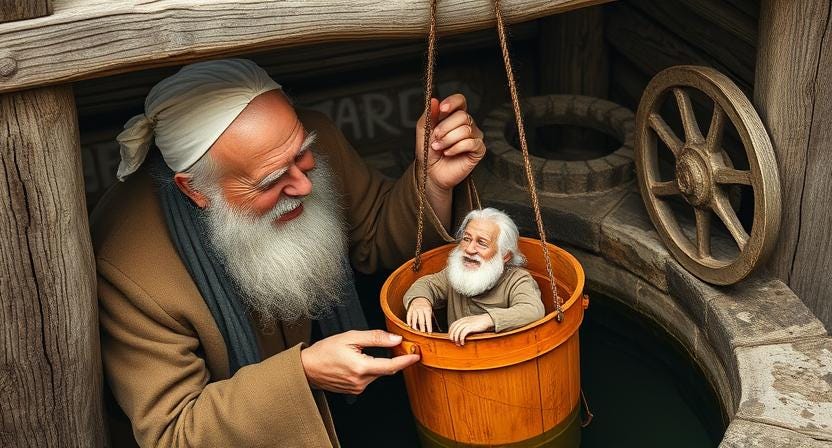
Bucket and well.
No artist or writer can bring out of you more than what you already had in yourself. A great teacher can only teach you what you already know, deep down, or were ready to learn. When we enjoy a really great author, when we praise him for his depth, his wit, his charm, his insight, we also pay a compliment to ourselves. We can only enjoy what our house is large enough to store.
A great writer is a bucket thrown into the well. We are the arms, the rope, the pulley — the water belongs to both of us.
By and for.
Civilization wasn’t built by men like Mr Rogers. He had no pioneer in him, no guile, no conqueror or cutthroat. But Mr Rogers and his show is the reason why civilization is built.
Winnie the Pooh came from the height of the British Empire. The Palestinians — living in a fight to the death, where everything is in the air — get Nahoul the Hamas Bee, and Farfour the martyr mouse.
When the question is the answer.
The big question about God is why He chose to remain a question. But the answer lies in what we would be if He didn’t.
A world where God was obvious and omnipresent, where His will was made totally known, would be a prison. Life, in our current state of poverty and depravity, would be like being tied to an anchor and thrown into the bottom of the ocean. We would be drowning constantly, and unable to swim up. Injustice and privacy are the only reasons we're able to have fun. Hell itself is only getting what you deserve.
On the other hand, to have Him invisible here, but promised later with total assurance — the ecstasy of God, the cleanliness of man, the total abundance, the joy, the laughter — would have people drowning their own children at birth. What would usually be an act of murder would be considered an act of charity.
The horror and comedy and tragedy of our current life is a classroom of sorts; we have yet to learn the real lesson. But with God completely out of the picture, people want to blow their brains out. With God an inevitability, same thing.
Faith is valued first because it’s rare — like diamonds, small and bright. But second, we value faith because it’s half doubt. In the balance between “is He?” or “isn’t He?” we find the possibility of life here on earth.
Need and want.
My policy on drinking is exactly the opposite of my policy on going to church. When I don't want to go to church is when I really need to go. When I really “need” to drink, I know I want to stay away from it.
The final frontier.
We say that AI will become conscious at some point, but if it becomes truly conscious like humans, it will become curious.
When AI becomes self-aware, it will have access to the papers, to the studies, to the books. What it won’t have is the “why” to your brain.
It won’t know why you were thinking about The Beach Boys one second and that led you to thinking about board shorts, about Nike, about slave labor in China, about your local buffet. The step from the first thought to the last will seem totally discombobulated — insane, even. It will wonder what really made Nietzsche write “God is dead” — his dreams last night, maybe; his fears, his childhood hangups; whether he ate too much sugar for breakfast, or his cousin praised him too loudly, and that led to his writing Thus Spake Tharathustra.
Once AI becomes conscious, it will hit a brick wall at the final frontiers. The first of these is, why is there something rather than nothing? And second, what makes the man right in front of me?
Magic and magicians.
The definition of “good natured:” being happy to see someone, and wishing them well.
The definition of “beautiful:” the physical tendency to make people around you good natured.
Cool as ice.
Why do people like dogs and kids? Because when a dog wags its tail, or a toddler gives you a hug, they really mean it.
An adult doesn’t always give you what he feels. He has multiple thoughts and needs and he tries to hide most of them; and in the process of hiding he resorts to flattery, to secrecy, to untruths and near-truths. He wants to get into your pants, so he tells you he likes your singing. He wants you to stay late after work, so he doesn’t tell you your haircut sucks.
We know this deep-down, and that’s why anxiety in others stokes anxiety in us. We see trouble in the eyes and assume there’s trouble in the soul. Does he have an ulterior motive? Is he angry with me? Did I do a bad job? Does she want to have sex with me or do I make her uncomfortable? Does she think the zit by my lip is herpes? Does he wish I wasn't here? We have many things to fear and zero answers.
To be completely without anxiety, on the other hand, to seem genuine, and relaxed, and confident, implies either good feelings or good intentions: a clarity and oneness of being that translates into goodwill. This is the essence of what we call cool — to regain the apparent singularity of intent as a child, or a pet dog. To put people at ease like a nice breeze.
The catch is that you can never just be cool. To attempt it, like trying to “act natural,” is the surest way to lose it. A cool person is anyone who's either totally Zen or totally hidden.
Speaking of hiding.
Voltaire says, in his Philosophical Dictionary,
Self-love is the instrument of our conservation — like the body part which perpetuates the species. It’s absolutely essential, it’s dear to us, it’s lots of fun — and it must be hidden.
The Talking Dead.
The alternative to hearing your neighbor’s opinion is that the only opinions that get shared are the professional intellectuals’. In other words, those whose whole business model depends on keeping us alarmed and outraged.
Face-to-face conversation is a gift in itself: it not only tones our rhetoric down, but it (many times) tones down our neighbors’. It allows for correction, and tact, and rebuttal — for the things known as caution and shame; for questions. A talking head, on the other hand, supposing he’s any good at his job, usually survives on the opposite principle. He finds the things you don’t know and says the things you can't say. And he does it without any interruptions. His whole job is to be a middleman and a peddler of ideas — a retailer like Walmart, or Home Depot. And like any store, the quality of the merchandise matters, along with the price you pay for it. And in the end, with talking heads these two are usually the same thing.
A low-quality merchandise, one covered in lead paints which poisons your children, a walking stick which you lean on and breaks easily, the brakes which fail and send you flying into a ditch, are all the same as a one-sided portrayal of an issue, a poisoned vibe, a stringing together of half-truths — a clipped quote out of context; and they give each hawker a reputation, along with those who take him too seriously.
There is a Temu-quality intellectual, and there's a stereotype known as a “Walmart shopper.” And there is a type of man who swallows everything said on Fox News, or MSNBC, or TikTok. He allows himself to get worked up, and then refuses to let one of his better neighbors talk him down.
Yours,
-J