

Dear H,
The Atlantic asked its readers whether they think reason or emotion is currently running the country, but to no avail — I suspect the answer’s going to be silly. Not just because the subscribers of The Atlantic are silly, but because the question itself (I think) is questionable.
Why? Aside from the fact that everyone describes himself as “reasonable” and prefers his own opinions and theories over everyone else’s, the most important thing to start with is that we can't reason without our emotions, because without our emotions we can't have a reason to reason. There’s no point in chasing things we don’t like, and there’s no point avoiding things we do; and when we try things we hate, it's usually to get things we love — eventually. That last part is the whole point of work and working out and running up the stairs to make whoopie. Life itself is based on feelings like sadness and lust and joy and disgust, and the question we really ought to be asking isn't whether “reason” or “emotion” is better, but whether one reason is better than another for the way we indulge our emotions.
What I’m telling you is Kant was wrong. In real life there’s no such thing as “pure reason” — i.e., a systematic pursuit of goodness that works for everybody all the time. Real reason — the having of multiple needs and desires and ranking them in importance and planning to get as many as possible — means there are good reasons and bad reasons, and reasons that are fun for some people and painful for others, and that the number of people they’re good for shift from epoch to epoch, and, more disturbingly, from moment to moment. Thus, asking everyone to be reasonable isn't actually asking everyone to be good. It's asking them to have your reasons, and to be interested only in your interests.
In other words we have bad news for anybody claiming a monopoly on reason, and especially the scientists and atheists. It’s that they put too much faith in themselves. Everyone starts out knowing nothing; none of us ever knows everything; our needs and wants shift drastically as we get older; our future selves will disagree with our current selves; all of us are biased and blinded some way or another, and each of us is prone to doing something crazy — or something wrong. Or both. The most common unbeliever-in-God is the baby: he knows and thinks nothing of the divine. The Schoolmen of the Middle Ages, on the other hand, clowned on for centuries because of angels on pinheads, were logical to a fault. Voltaire says of the lunatic,
We have seen idiots who could calculate and reason in a more extraordinary manner. They weren’t idiots, then, you tell me. I beg your pardon — they certainly were. They rested their whole superstructure on an absurd principle; they regularly strung falsehoods together. A man may walk well and go astray at the same time; and the better he walks the farther astray he goes.
The ideal of reasoning, that we can
learn abstract principles from our past and use them to plan ourselves a good future,
that we can balance them with any contradictory principles and interests, and
that we can actually carry our principles out against any unforeseen obstacles or the possibility of personal weakness*
— this ideal, I say, is lofty, and beautiful, and worth all the struggle. But it has almost always been only an ideal. And the only thing that's gotten in the way of it is us — the people who thought of it in the first place.
The problem with the modern era is that we don’t know what reason is, and that if you’re following a bad map, or you don’t know how to read one, you can reason yourself right into a ditch. Modern people don’t know reason is different from wisdom, and that having access to information isn’t the same as being wise. We confuse nice ideas with good ideas. We confound newer things with better things. We judge men not by what they can do — whether the world around them is more beautiful, and safe, and functional — but rather by what they permit. We believe too easily in our teachers and professors and so-called “experts.” We refuse to really listen to the arguments of our enemies. We think that scientists and statisticians can tell us more about ourselves than we can ourselves. We live in an age of faith — especially in the godless. We live in social superstructures theorized in books that few of us have read and even fewer understand. We make fun of the Dark Ages and never wonder why we also don't have a Cicero. We laugh at The Inquisition, and then jail heretics because they won't admit there’s a thirtieth gender.
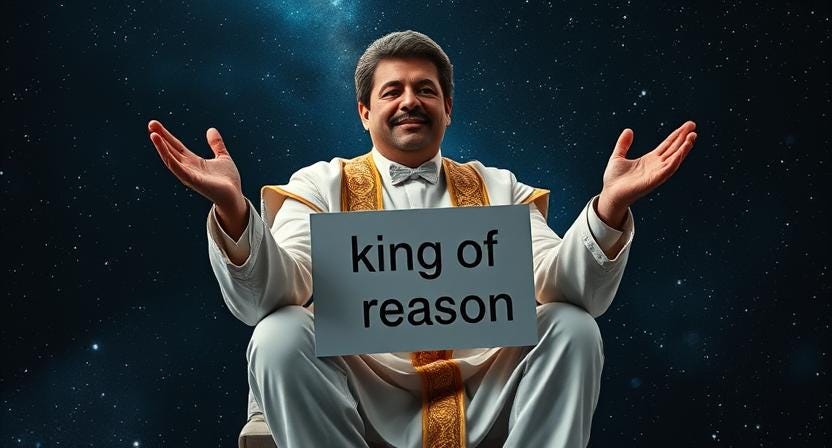
So ask yourself, in light of what I just said, whether this means that reason or emotion is winning. Regardless of what the editors at The Atlantic believe, I'd say reason is winning — and that we got where we are because we picked all the wrong reasons.
Yours,
-J
July 17th, 2016 (kinda)
*Rochefoucauld says of those who carry their convictions through fire,
Perseverance should be neither praised nor blamed: it is merely the continuance of tastes and emotions which we can neither shed nor acquire.
But is this really true? I like the description here, but not so much the prescription.
Nature gives us both souls and faces, and when they're good it’s worth singing praises to either of them. But motives and mindsets are like fashions: they're constantly on the move, and we never really know what’s hanging in the balance. A little nudge here, a compliment there, can be the difference between long hair on a princess and an awkward set of bangs. A touch too little credit (or no credit at all) can be the difference between a hard worker and a serial loafer. We never know how much morality is just a bald need for conformity. We never know how much heroism is actually just vanity.
As always, the wise thing to do is to dish praise out when you like something. You never know if you’ll see it again, and you never know (beyond this) who’s listening, and how it might pay out. Nature Herself gives profusely to us; but society, the environment, and the onslaught of time just as easily steal away. Great things have been lost because somebody gets too bored, or tired, or just can't see the payout. The hero and the bard are thus two sides of the same coin. One of them does the saving, at great risk or expense, and the other one makes sure the saving was worth it. A medal or a song is a bulwark against the ocean. A sea of possibilities beats against a miracle, and we prop up what little we can to keep the waves from washing it away.
So thank the husband who goes to work every day, who fixes things, who mows the lawn. Thank the wife who greets you every day with a clean house and happy kids and a hot meal. If you like the way someone fixes your car, or set up chairs at your church, or even serves you a burger, let everybody know about it. If Isaiah 42:8 is to be trusted, I doubt even God likes to dish things out without eventually getting a point and a wink.