

Dear M,
What does a revival look like? It depends on who you ask, but most of the answers are silly, and can make you look like a real boob.
When Jonathan Edwards preached his most famous sermon, Sinners in the Hands of An Angry God, it was said that people started shrieking and crying, probably out of the fear of Hell. Onlookers attributed this to the Holy Spirit, since it was said Edwards spoke softly the whole time; but the idea caught on, and now, when the Holy Spirit is said to hit you, you end up dancing, or babbling, or moaning — none of which, by the way, you'd expect to see at a rave, or the loony bin.
I imagine it caught on because these things make an impression, unlike the other things (Paul tells us) God does to people in the Bible. After all, love joy peace patience kindness goodness gentleness faithfulness and self-control all lack a certain showmanship, and take time to prove, and can't be put into statistics; and when you're in a hurry to start a movement, you have to prove something inside you is actually moving. So you put on your clown nose and jump around and yell.
Plus once somebody goes bonkers you’ve got to keep up with them, especially if they’re from another church. You can't just let somebody else have more Holy Spirit than you. Then it looks like you don’t really have Him. When the first Hindu lady lost her husband and jumped into his funeral pyre I imagine it caught everybody off guard, and everybody marveled that a woman could love a man so much that she’d kill herself like Juliet. So when the next lady lost her husband she didn't want to look bad. So into the fire she went, and the next lady, ad infinitum, until jumping into the fire became a routine, even if you were married to a cheater, or a beater, or a boob. Which many of the women were. And if you didn’t jump into the fire people would get mad and want to throw you in there anyway. What a terrible wife, they’d say.
This is the same spirit we put into a lot of things, like making poor men buy their fat girlfriends diamond rings when he can barely pay the rent — proof neither of fidelity nor responsibility but the shimmer of it: fool's gold bought at sale price from Jared’s. An outside thing masquerading as an inside thing. An easy-to-prove thing pretending to be a difficult-to-prove thing. In a society that loves no-fault divorce, oftentimes a scam thing. I would argue it’s okay to signify spiritual things with physical things, since all spiritual truths become physical truths anyway. This is what a marriage ceremony is, after all. But, spiritually speaking, if you confuse the ceremony with the marriage, you end up with the Pentacostals — people who whoop and yell for an hour, on cue; totally possessed by God until real life starts. At which point He takes a break and leaves them to their own devices.
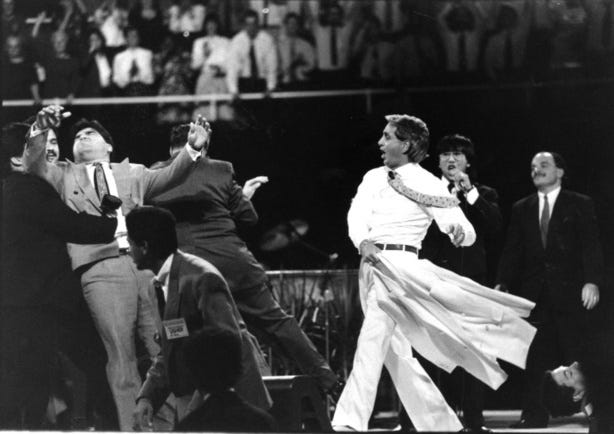
Not that God is all ice and no fire. I imagine God, who has many moods Himself — some of them “unChristian” to many Christians — inspires those same moods in others; and in fact I would expect this to be the definition of enthusiasm*. Not that God has the same effect on everybody, but that He breathes a mood into you about something — maybe about someone; and the mood is strong, and righteous, and holy. Like the wind that blows wherever it pleases. You hear its sound, but you can’t tell where it comes from or where it is going. I mean something that grabs you, and maybe makes you cry in the middle of the night, maybe makes you laugh out loud, maybe makes you stab a fraud. Either way something you can’t turn into a routine.
But these feelings are difficult to judge both in ourselves and others, so God left us with a list of attributes so borderline-banal that nobody can see them and say we're having a revival. By the time the revival becomes obvious it's probably well over. You had a revival. And the new man you've become snuck in unnoticed, almost; quietly, through the back door of your soul, and is here to stay, and everyone around you is better off for it.
Yours,
-J
P.S. A counterpoint.
When David danced for God he danced so wildly that his wife took one look at him and sneered and almost instantly became an old maid. From 2 Samuel 6, New Living Translation:
And David danced before the Lord with all his might, wearing a priestly garment. So David and all the people of Israel brought up the Ark of the Lord with shouts of joy and the blowing of rams’ horns.
But as the Ark of the Lord entered the City of David, Michal, the daughter of Saul, looked down from her window. When she saw King David leaping and dancing before the Lord, she was filled with contempt for him.
[…] When David returned home to bless his own family, Michal, the daughter of Saul, came out to meet him. She said in disgust, “How distinguished the king of Israel looked today, shamelessly exposing himself to the servant girls like any vulgar person might do!”
David retorted to Michal, “I was dancing before the Lord, who chose me above your father and all his family! He appointed me as the leader of Israel, the people of the Lord, so I celebrate before the Lord. Yes, and I am willing to look even more foolish than this, even to be humiliated in my own eyes! But those servant girls you mentioned will indeed think I am distinguished!” So Michal, the daughter of Saul, remained childless throughout her entire life.
Like all interesting Biblical passages, this leaves us with more questions than answers. One of them being, how much of David did the servant girls see? And did Michal have a good reason to be mad? And even if she was rightly mad, did she cross a line because David’s heart was in the right place?
This last part is probably the most important of these, because it hints at the bigger question. Which is, when a man really feels for God, where does he end and God begin? Or, to put it another way, isn’t all real worship a process of God acting first — and then people catching fire from the sparks? I don’t speak lightly here: I think this is why God acts for us in the first place.
It's easy to criticize a routine of dancing and hollering, but to touch the issue too roughly is to (possibly) insult one of God’s children, I think; and if we were meant to love God at all, we were meant to lose ourselves in Him. And maybe that makes us look like fools to people who don’t love Him, at least at the same moment. But can any man really love a woman without turning into a fool? And could we expect any less about God** — the designer of women? I leave these questions not to the theologians, but to the lovers.
This reminds me of a passage in The Autobiography of Mark Rutherford, where the author complains about romance novels, and how the writers keep explaining the same process, over and over again, and how people keep buying them.
"I do not agree with you," said Theresa. "I disagree with you utterly. I dislike foolish, inane sentiment—it makes me sick; but I do believe, in the first place, that no man was ever good for anything who has not been devoured, I was going to say, by a great devotion to a woman. The lives of your great men are as much the history of women whom they adored as of themselves. Dante, Byron, Shelley, it is the same with all of them, and there is no mistake about it; it is the great fact of life. What would Shakespeare be without it? and Shakespeare is life. A man, worthy to be named a man, will find the fact of love perpetually confronting him till he reaches old age, and if he be not ruined by worldliness or dissipation, will be troubled by it when he is fifty as much as when he was twenty-five. It is the subject of all subjects. People abuse love, and think it the cause of half the mischief in the world. It is the one thing that keeps the world straight, and if it were not for that overpowering instinct, human nature would fall asunder; would be the prey of inconceivable selfishness and vices, and finally, there would be universal suicide. I did not intend to be eloquent: I hate being eloquent. But you did not mean what you said; you spoke from the head or teeth merely.”
*The word enthusiasm comes from the Greek, and literally means "to be inspired or possessed by a god.” And this brings us to the word inspired, from the Latin, which means to breathe into. We use these words casually, oftentimes without realizing what they mean — and that they’re the basis of all meaning.
**We know men kill over women all the time. But I only know of two wars started over a woman: the Trojan War, and the overthrow of the Tarquins in Livy. Now, how many wars are there over God? How many people heard somebody describe God the wrong way (or maybe the right way), picked up their swords, and hacked other believers to death? Is this hatred — bigotry, maybe? Or is it love? Maybe a mixture?
Only God knows, and like with the ladies, I’m not so sure He always hates it. Biblical history aside, I came not to bring peace, but a sword. His words, not mine.
***One of the reasons worship gets turned into a sideshow is that we’ve relegated it to church services and cramped it. It should encompass most areas of life, from waking up to making war, but today we see it as singing and shouting and dancing; and that forces people to make up for lost time. And I think they tend to overcompensate.
But try an experiment. Try emptying the dishwasher for your wife in the morning before she gets up, or picking up a piece of trash at work when nobody’s looking, or leaving a ten-dollar bill under a book at a struggling friend's house, or looking a customer right in the eye and thanking them and meaning it, or forgiving somebody a slight, or teaching your kid an old hymn — and when you do any of these, putting your eye on God and giving Him a wink. Let Him know that you know He loves you and you’re passing it on to others. Note then how good it feels; how fresh, how freeing, how full of light. It feels this way because you're born for it. And then you can rest easy singing on the weekends.
Sometimes I think you are channeling Chesterton, if I believed in that sort of thing, which I don't. But you've penned another observation that not only sees the world as Gilbert saw it, but knows how to tell us about it with the same sort of jovial spice, like sprinkling us with just enough acid to make us sit up and pay attention.
I love this essay. It was written about me I think. Sometimes I think wrong but I think often. Well done J.