

Dear L,
Listen up, because what I’m about to tell you in this next paragraph is serious.
I'm not advising you to see Midnight Mass: that's up to you. I’m also going to ruin the whole show with spoilers. If you read this essay and decide to see Midnight Mass because it sounds great, it is — and it will be less fun because of what I say, and it will be every bit as disturbing. The big difference between Midnight Mass and other horror shows on Netflix is that it can only be disturbing if you're really, truly, deeply religious. But on the flip-side, that’s also the only way it can be really beautiful.
How, you ask? Because people without a healthy dose of religion can’t understand it. Mike Flanagan either is or was a deeply devoted Catholic; and that means the themes of Christianity, the miracles of Paul and Jesus, the text of Scripture, and even the best hymns are all used here to great effect. Hell, this is the only series I'm aware of that has better taste in church music than most churches — a catalogue so good it was even featured in an article by Men’s Health Magazine. Listed in the soundtrack is nothing less than Abide with Me, Holy Holy Holy, Faith of Our Fathers, Nearer My God to Thee, Lead Kindly Light, and a whole slew of hymns you'd only know and love if you've been to a serious church for a long time.
And this is only the music. More impressive is that the main villain — Bev, a Pharisaical bitch on a crusade — quotes Scripture fluidly and profusely, twisting and bending sacred passages in a frenzy to spread herself and the parish over the Gospel. Proof that the Scriptures are so copious and diverse that you can use them to justify almost anything.
What makes Midnight Mass so different is that, usually in a show like this, Bev is the only Christian, and she exists to paint Christians as a bunch of uptight, selfish, hypocritical assclowns. In this show she’s only one of the Christians, and she's outnumbered and counterbalanced by a priest and his parishioners — people who genuinely love Jesus, and spread the real Gospel. At least at first.
The most disturbing thing about Midnight Mass isn’t what villains do with hymns or with Scripture, though: it’s what they do with Communion. This is because Midnight Mass is — yes, I’m being serious — a show about a vampire. And it shows what happens to a small, decaying island village when their Catholic priest gets bitten by one.
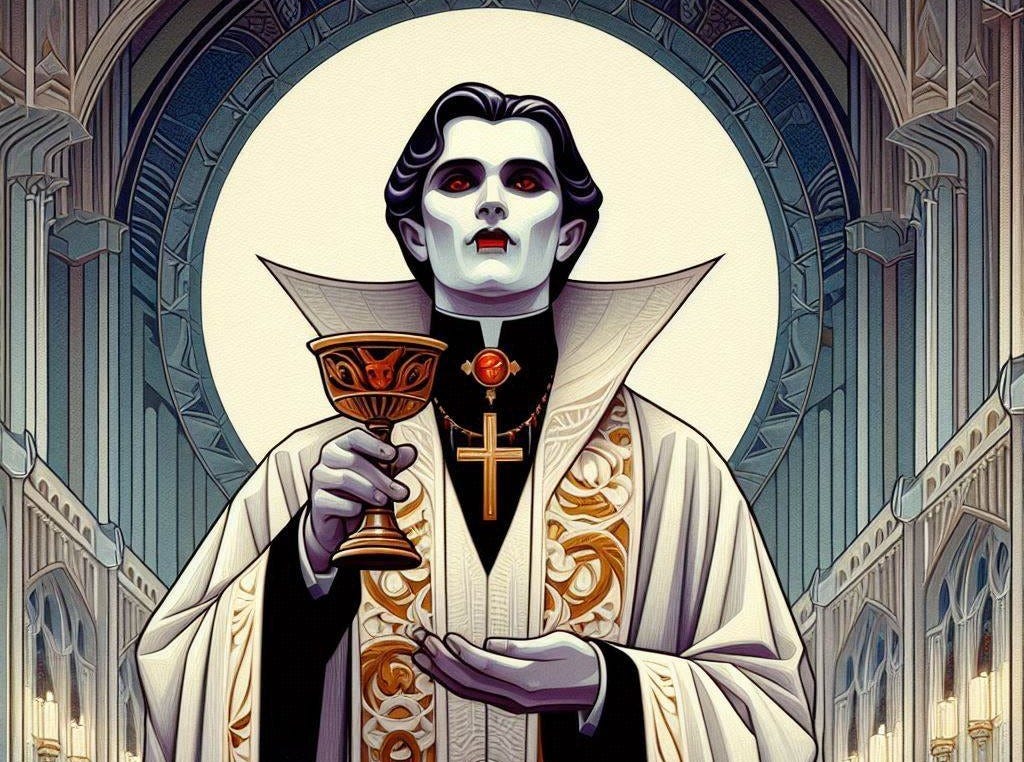
The story takes place on an island where almost everybody is messed up. Their main source of income, fishing, had been ruined by an oil spill years ago and the fishermen never recovered from it. Everything is in a visible state of decay. Some of the people are drunks and abusers. Others are good Catholics whose kids get successful and leave them behind like the Prodigal Son. One kid is an ex-con for getting trashed and driving over a little girl. One gets knocked up by a loser, others get high. The town drunk drowns himself every day in booze because he was out shooting guns and accidentally maimed the mayor's kid — who’s now in a wheelchair for life. And then there's Monsignor Pruitt, a 90 year-old priest in the full grip of dementia.
On his last legs, this priest books a trip to the Holy Land and gets lost by his tour guide outside the walls of Jerusalem. The poor guy ends up wandering through a sandstorm in total blindness until he comes to a cave, inside which he meets a giant being with wings and glowing eyes. It bites him and drains his blood and he dies; but before he gets to the Pearly Gates, the vampire sees him praying and has pity on him. It slits its own wrist and has the priest drink the blood, and he wakes up the next day and finds himself back in his 30’s — not just healthy, but in full possession of his wits. Full possession, that is, aside from the fact that he thinks the vampire is an angel, and that God raised him from the dead with the Eucharist.
When he comes back to the island, he brings the vampire in a box and tells people that Monsignor Pruitt is sick but recovering on the mainland. He begins giving simple Gospel messages and reaching out to the sick and the outcasts at first; but then the vampire gives him an idea. If you were healed through Holy Communion, why not put angel blood into the altar cup, secretly, and pass it around to the congregation? This results in a series of miracles, and Midnight Mass has the honor of being the first feel-good vampire series I’ve ever seen. I'll add that it goes downhill quickly after that. By the time the show ends, the more religious you feel, the more disturbed you'll be. This isn’t a prediction: it's a promise.
What's strange about this show isn’t just that it disturbs the genuinely religious — and I would say only the genuinely religious. It’s that it’s also one of the only TV shows I've ever seen that actually inspires them. When Monsignor Pruitt talks to the sick and the broken, he's not just some sloppy, fruity, half-baked feel-good liberal pastor on Netflix. He appeals to things all Christians know and love and want but that we’re starved for.
Mike Flanagan doesn’t just show you what Christianity is, though. He shows you the honor in Islam, and Buddhism, and even a principled atheism — revealing what these people really believe as if they were speaking for themselves: not a cheapo whitewashed Netflix glow-up or a hit-job, but a panoramic perspective of sometimes-meshing, sometimes-conflicting worldviews that can't all be true, but are actually believed by people who can’t make sense of God — yet hang on to some aspect of Him for dear life. In other words our actual position. (I’m told this acrobatic display of moods and perspectives is why Dostoevsky was a genius. And maybe he is. But I read The Brothers Karamazov and quite frankly, I think Mike Flanagan did it better).
There are so many touching, beautiful, honest scenes and dialogues in the show that despite its being a horror film, it uplifts just as much as it cuts down — maybe more. In the end, everyone, despite their many flaws and errors, finds some kind of redemption except Bev — a monster who, even after all the horrible things she does, is told that God loves others just as much as He loves her. A wild and uncomfortable statement that shows Mike Flanagan knows the Gospel, and that it’s a call to idiots and assholes — not just to the faithful.
Despite all this, as I said earlier, Christianity isn’t the only worldview expressed clearly and beautifully on Midnight Mass; and, in fact, Buddhism gets no mention (at least not by name), but it gets the most poignant delivery in the whole show. When Erin’s bleeding out on the floor, instead of seeing angels like she thought she would, we get a peek inside her mind, as she realizes death is just a phase of life:
Myself. My self. That's the problem. That's the whole problem with the whole thing. That word, "self." That's not the word. That's not right. That isn't. How did I forget that? When did I forget that?
The body stops a cell at a time, but the brain keeps firing those neurons. Little lightning bolts, like fireworks inside, and I thought I'd despair, or feel afraid, but I don't feel any of that, none of it, because I'm too busy. I'm too busy in this moment. Remembering, of course. I remember every atom in my body was forged in a star. This matter, this body, is mostly just empty space after all. And solid matter? It's just energy vibrating very slowly, and there is no me. There never was. The electrons of my body mingle and dance with the electrons of the ground below me and the air. I'm no longer breathing. And I remember there is no point where any of that ends and I begin.
I remember I am energy. Not memory. Not self. My name, my personality, my choices, all came after me. I was before them, and I will be after, and everything else is pictures picked up along the way. Fleeting little dreamlets printed on the tissue of my dying brain. And I am lightning that jumps between. I am the energy firing the neurons and I'm returning. Just by remembering, I'm returning home. More galaxies in the universe than grains of sand on the beach.
And that's what we're talking about when we say God. The one. The cosmos and its infinite dreams. We are the cosmos dreaming of itself. It's simply a dream that I think is my life, every time. But I'll forget this. I always do. I always forget my dreams. But now, in this split-second, in the moment I remember, the instant I remember, I comprehend everything at once. There is no time. There is no death. Life is a dream. It's a wish...made again, and again, and again, and again, and again, and on into eternity. And I am all of it. I am everything. I am all. I am that I am.
— a monologue worthy of Thich Nhat Hanh, or Alan Watts, or Ram Dass, and which sounds downright sacrilegious in the mouth of anyone other than Jesus. But then again this is how He sounded to the Jews too: a reminder that what we take for granted now and pretend we’d accept was at one time shocking, and crazy-sounding, and dangerous. Just like drinking God’s blood with your friends.
There are so many moments and conversations worth mentioning here that cutting them down to a few feels wrong. In one part, Annie Flynn, one of the more lovable Catholics in the series, is buying time for others to run away. She knows she's about to be murdered and confronts Bev and says, for all of us, really,
Never made much sense to me. We all say there's a heaven. And it's waiting for us. Then we claw, fight, beg for a few minutes at the end. Minutes.
One of the many scenes that leave you thinking and feeling at the same time.
Midnight Mass is at its best when dealing with death and dying and suffering honorably, in fact. It makes no claims to truth: it only presents us with what we know, or think we know, or claim to know. And this leads us to the biggest point — the fact that people with even the best intentions can take everything the wrong way and get us all killed. Monsignor Pruitt is a genuinely good person and maybe even a better Christian — he’s humble, and kind, and generous, and honest about his failures. But even this can't keep him from mistaking the Christ and the Devil: a position that many of us are in, and usually without our knowing it.
For instance.
When you have a creed your whole life and it bumps up against something concrete — something you can smell, and see, and touch — what do you do? What is an old priest with dementia supposed to think when his religion centers around eternal, boundless life, and the eternal life comes from drinking God’s blood — and that he was personally raised to life by drinking the blood of “an angel”?
The truth is, we’re all Monsignor Pruitt on some level: a mob of guessers trying to fit the Bible and the church and the legends into the real world: to believe God still “answers prayers” while Christians get thrown to lions — that God created Adam and Eve on the sixth day and the fossil record says it’s closer to six billion — that the Holy Spirit is supposed to guide us into all truth and we’re split into a thousand warring sects — that Christians are the light of the world (Matt 5:14-16) and born hopelessly deranged until death (Jer 17:9). If we sin, we know the light of God is gone from us (1 John 3:6). If we say we’re clean, we prove it is (1 John 1:8).
God is real, and we crave Him, we need Him: we need to believe we've either heard from Him or are hearing from Him. He lives in us and through us and yet we look for Him, and beg for Him, and have a hard time telling when it’s really Him. And then Paul says even the Devil disguises himself as an angel of light. And He’s right. The sacred things and the rotten things are all wearing the same clothes. And it’s easy sometimes to mistake one for the other. God’s mercy is just as much for our sins as for our righteousness**.
That's why God is the hero, and we aren’t. And that's why Christianity matters so much. Because in the end, no matter how much we polish our shoes and straighten our ties and quote from the Scriptures, deep down inside, we’re all a bunch of scoundrels and fools. And God gave Himself for us — no: He gives Himself for us, because He loves us anyway, and He would pay anything, even in His own blood, to be with us for eternity.
That's why Midnight Mass is horrific. Because it shows us who we really are. And it shows us what we can be. And it turns the center of the universe on its head — the shedding and drinking of God’s blood — and makes it into a horror show.
Yours,
-J
P.S. I'm not stupid. I know very well what I’ve done here, and that after a smattering of warnings there’s still curiosity — that cat-killing feeling, tempting every single fun and interesting daughter of Eve to just go ahead, try it, what harm could it possibly do?
So, do you? Do you just watch the show after all my warnings about it? Can you hear about all the good things in it and ignore what I also said: that in some parts it’s really disturbing?
That, dear reader, is up to you — we’ve already been kicked out of the Garden once, and although we can usually tell the difference between good and evil, the machinery we got works spotty sometimes, and we never really got tired of either apples or sex or even a good story.
The question is, am I the Serpent here? Or is evil — even the delectable types — meant to be recognized and analyzed and pointed out: a huge warning label for the discerning, and an I-told-you-so for those who press on anyway and end up in the infirmary?
My answer, to myself, is small comfort. I can't be the Serpent because I'm Adam. My wife got me to watch Midnight Mass after a calculated refusal of almost a year. So I don't just suck for writing such an enticing review. In the end I'm just as much a sucker as anybody else.
*At first glance, the only religious perspective left out was the Jewish one — at least explicitly. But Monsignor Pruitt did go to the Holy Land, and they couldn’t just call the show Bit By A Jew.
**Regarding being forgiven for our “righteousness,”
Gone are the days of raiders taking our women and highwaymen conquering whole nations. We’re now plagued by our do-gooders and social justice warriors and philanthropists. Mao and Lenin wanted to create a world where everybody was free and ended up torturing them in slave camps. ISIS wants to nuke the world and usher in an era of the saints. The so-called anti-racists cover up the crimes of child-rapers and drug dealers and leave our borders wide open to the world’s felons. Hitler believed deeply in science, and because he believed deeply in science he believed honestly in evolution — and because he believed honestly in evolution he wanted to create a world where the smartest and most beautiful and most orderly people could thrive. He blew the world up, and now Antifa hates a third-grade non-socialist version of Hitler so badly that they turned into a bunch of violent dysgenic second-wave brownshirts.
There's no limit to the ugliness of our goodness. There's nothing which can't be sanctioned under the guise of our charity. The Millennium has arrived and the saints are a pain in our asses.
Good one, J. Good one.