

Dear T,
Recently I said that if you’re going to have a full life, one where you want to fit some bite-sized wisdom into the crevices of a busy schedule, you’re going to need Pascal, Rochefoucauld, Ben Franklin, and Marcus Aurelius. But I added a Buddhist named Thich Nhat Hanh to the list and I’m pretty sure I confused some people.
Thich of course is nowhere near as well-put, or sharp, or even diverse in thought as the others. So why did I add him? Because of passages like this:
It is of no use to sit in a peaceful forest if our mind is lost in the city. When we live with a child or a friend, their freshness and warmth can relax us. But if our heart is not with them, their precious presence is neglected, and they no longer exist. We must be aware of them to appreciate their value, to allow them to be our happiness. If through carelessness and forgetfulness we become dissatisfied with them, and begin asking too much of them or reprimanding them, we will lose them. Only after they are gone will we realize their preciousness and feel regret. But once they are gone, all our regrets are in vain.
Around us, life bursts forth with miracles—a glass of water, a ray of sunshine, a leaf, a caterpillar, a flower, laughter, raindrops. If you live in awareness, it is easy to see miracles everywhere. Each human being is a multiplicity of miracles. Eyes that see thousands of colors, shapes, and forms; ears that hear a bee flying or a thunderclap; a brain that ponders a speck of dust as easily as the entire cosmos; a heart that beats in rhythm with the heartbeat of all beings. When we are tired and feel discouraged by life’s daily struggles, we may not notice these miracles, but they are always there.
He adds later,
You make yourself available to life and life becomes available to you.
Thich isn’t a barrage of witticisms and observations: he’s a slew of practical advice to help you slow down, reexamine the magic of your life, and enjoy it instead of just barreling through. In one passage he writes,
There is a story in Zen circles about a man and a horse. The horse is galloping quickly, and it appears that the man on the horse is going somewhere important. Another man, standing alongside the road, shouts, “Where are you going?” and the first man replies, “I don’t know! Ask the horse!”
— an insistence that your imagination is a tool to be used, but it often gets the best of us, dragging us down roads we’d rather not go because we forget that we’re in the driver’s seat. He reasserts, over and over again, that happiness and spiritual health are a discipline, not a given; and besides advice like this there are all kinds of passages that Christians will pick up on as borderline Scriptural. To Paul’s God loves a cheerful giver, Thich explains why:
The incense is an offering to the Buddha, but does the Buddha really need incense? This is actually an offering of peace, of joy, and of concentration.
— the Christian idea that God cares more about your spiritual state than your physical one, but that we often have to use the physical one to represent the spiritual. And it’s easy to confuse them.
Thich is constantly reminding us that we’re looking too hard for the divine when God put it right in front of us. When Christ says an adulterous generation seeks for a sign, Thich says, The miracle is walking on the earth, not walking on water or fire. We miss God too many times not because He’s too far, but because He’s too close.
And we’re all taught to pray at meals, but Thich teaches how to turn meals into a prayer.
When I hold a piece of bread, I look at it, and sometimes I smile at it. The piece of bread is an ambassador of the cosmos offering nourishment and support. Looking deeply into the piece of bread, I see the sunshine, the clouds, the great earth. Without the sunshine, no wheat can grow. Without the clouds, there is no rain for the wheat to grow. Without the great earth, nothing can grow. That is why the piece of bread that I hold in my hand is a wonder of life. It is there for all of us. We have to be there for it. Eat with gratitude. And when you put the piece of bread into your mouth, chew only your bread and not your projects, worries, fears, or anger.
When I said to "read Thich and reclaim your life from the garbage pail” I never meant that life itself was garbage. I only meant that we tend to throw it away.
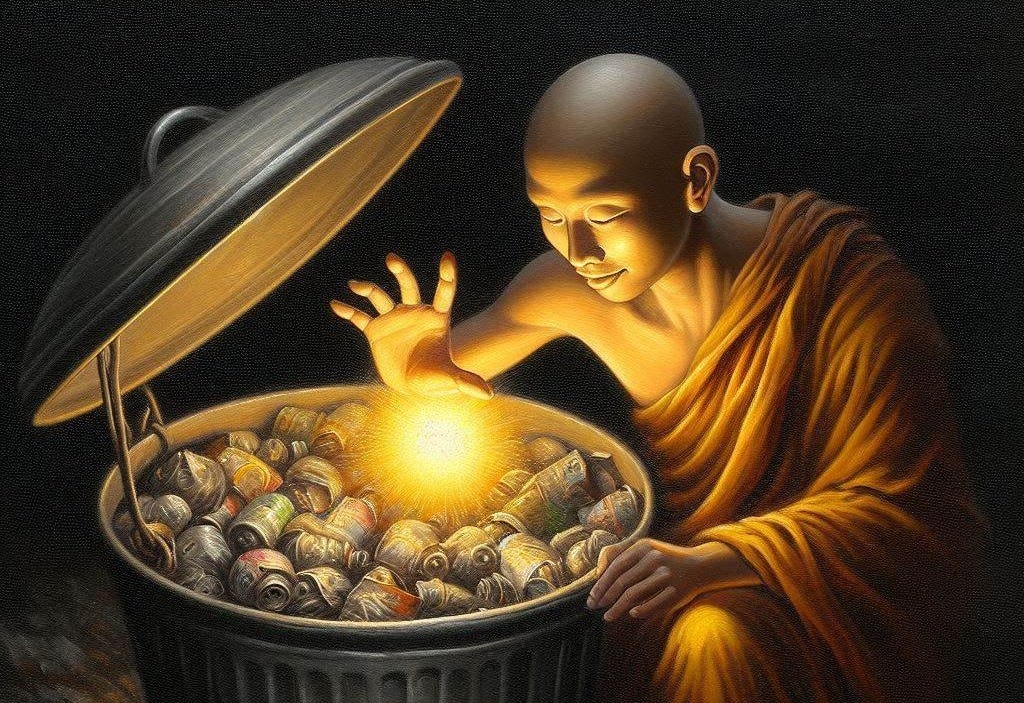
Thich says things I outright disagree with, of course — like Moses and St Paul do. He has rules I can't really follow and won’t hold others to — like some parts of the Sermon on the Mount. He speaks of gods like I speak of angels and demons and prophets and saints — that is, with a giant asterisk. But beneath all the things I take with a wink, there’s a bedrock foundation of practical advice: ways to make you stop for a moment, realize what God gave you, and really enjoy it. Paul asks you to be grateful for everything. Thich Nhat Hanh shows you — a busy, distracted, forgetful being — how.
This is why I think Christians should look into Buddhist authors like Thich and maybe hear the lectures of Ram Dass. It’s halfway to where we need to be. When you take the practice of Buddhism at face value, you learn the practice of gratefulness. When you have the other foot planted in Christianity, you know who to thank. And I think it makes all the difference.
Yours,
-J
P.S. But J, you might ask here: how much of Buddhism do you actually swallow? Just enough to get a buzz off the stuff — not enough to get trashed.
Buddhism is a distillation and magnification of certain truths; particularly those which God and Mother Nature hardwired our neurology to ignore. But instead of sipping on them and swirling them around in a snifter, it tries to drown you in them — a spiritual keg-standing which sends you tripping over half-truths and sometimes talking like an ass.
For instance, his teaching on birth and death makes half-sense:
When we look at a wave on the surface of the ocean, we can see the form of the wave and we locate the wave in space and time. Space and time are not two separate entities; space is made of time and time is made of space. Looking at a wave from the perspective of the historical dimension, it seems to have a beginning and an end, a birth and a death. A wave can be high or low, a wave can be long or short—many qualities can be ascribed to the wave. The notions of “birth” and “death,” “high” and “low,” “beginning” and “ending,” “coming” and “going,” “being” and “nonbeing”—all of these can be applied to a wave in the historical dimension.
This is all true, of course: we are swallowing nature and being swallowed by it — a rehashing of from dust you came, and to dust you shall return. But instead of leveling man to the dust, Buddhism elevates dust to the man:
Nothing can die. You cannot reduce being into nonbeing. Life is a process of change. Without changing, life is impossible. Once you accept that with joy, there is no fear.
— as if you and the molecules that make you and the organisms which eat them up are the same things: something which isn’t only untrue, but silly and cold. And if you don’t think so, try telling this to anyone who’s in love or just lost a child. The wave becomes a non-wave and a child becomes a non-child; but there will be many waves for us, and only one father, only one firstborn, only one first love.
Another of the doctrines he mangles partially (but badly) is the one on Interbeing. He says, with some wisdom:
If we look into this sheet of paper even more deeply, we can see the sunshine in it. If the sunshine is not there, the forest cannot grow. In fact, nothing can grow. Even we cannot grow without sunshine. And so, we know that the sunshine is also in this sheet of paper. The paper and the sunshine inter-are. And if we continue to look, we can see the logger who cut the tree and brought it to the mill to be transformed into paper. And we see the wheat. We know that the logger cannot exist without his daily bread, and therefore the wheat that became his bread is also in this sheet of paper. And the logger’s father and mother are in it too. When we look in this way, we see that without all of these things, this sheet of paper cannot exist.
Also true, of course; an I, Pencil of the spiritual world which reminds us that 1) everything has its existence way beyond itself, and 2) we are all shifting our manifestations, our beings, our very egos, into and out of the everything.
But the Buddhists run too far again here, I think. They pretend that this I —a distinct and beautiful thing, carved out of the cosmos and staring right back at itself — is a mirage:
We already are what we want to become. We don’t have to become someone else. All we have to do is be ourselves, fully and authentically. We don’t have to run after anything. We already contain the whole cosmos. We simply return to ourselves through mindfulness and touch the peace and joy that are already present within us and all around us. I have arrived. I am already home. There is nothing to do.
But here comes the obvious question. If I already am what I want to become — somewhere in the universe, at least — then why write the book? Why read anything at all? Why meditate, why not let my mind run wild, why try to be in the moment*? Let’s take it one step further: why brush your teeth? How many times do you have to tell yourself you’re one with the universe before you prove you kinda aren’t?
Some of you will say this philosophy is hooey, and that Buddhists preach one thing and are forced to practice another. You’ll argue, perhaps, that living entirely in the present would kill you; that the mind exists to project us into the future; and that a too-close living in-the-now would turn us into boobs and vegetables and mooches. You might even argue that what makes us human is our ability to dream up other dimensions and live in them. And this is all true.
But I would argue that Christians are hypocritical in the other direction. We argue that this life is “rubbish” (in Paul’s words) and that it should be thrown away for what’s coming. Then we see a pair of tits or the news or get hangry and we forget all about eternity. We say “God is in charge” and still vote, and worry, and fight**. We say it’s a good thing to die and be with God and still do chemo at great pain and end up crying at funerals. Saint Paul says every saint is God’s choice. Then he says it’s his personal duty to go out and make saints.
I’d argue that both camps look silly because in a single infinitesimal moment — which is all there ever is — the mind can only focus hard on one side or the other. And we have to shift back and forth to live and enjoy living. Wisdom is the planning of a better “right-now” for later. Success is the enjoyment of the “right now” we already have right here.
We call the valuing of the present too far over the future “temptation.” We call the valuing of the future too far over the present “ungrateful.” The present is beautiful and we’re forced sometimes to ignore it. The future is ecstasy (because of God’s grace) and the current reality obscures it. We were born to shift between the two, amphibious. And we are uncomfortable in each. True wisdom isn’t living entirely in one or the other. It’s knowing not just which to shift to, and to what degree, but when.
It’s true that everything is shifting, turning, bursting with life; and we’re wavering backward and forward, gutterward and skyward. And we have no choice about the shifting. We can pretend to sit still and life moves well ahead of us. And the mind’s job is to keep up and maybe get ahead of life. Sometimes we soar and other times we stumble. Sometimes because of what is and other times because of what might be. Each is an antidote when the other one fails us. And if we preach too far one way or the other we miss the beauty of it all.
Heaven and Hell are both present and future. We were told we can’t have our cake and eat it too, but God has decided this is true in every way except the best way. We are intended to be showered with blessings as we grow into Him. And we are all sliding towards Him, one way or another. By connecting with Him we have peace in the moment and hope for the future — a drive to bless and to heal and to sing and to dream. And Thich helps us recognize half of the puzzle. St Paul helps us recognize the rest.
*Because Thich's teachings are universal and practical, there are parallels and counterpoints made to Thich from every great prophet and philosopher.
Eric Hoffer writes of man and nature,
Nature attains perfection, but man never does. There is a perfect ant, a perfect bee, but man is perpetually unfinished. He is both an unfinished animal and an unfinished man. It is this incurable unfinishedness which sets man apart from other living things. For, in the attempt to finish himself, man becomes a creator. Moreover, the incurable unfinishedness keeps man perpetually immature, perpetually capable of learning and growing.
And Chesterton, adding to Thich's musings on mindfulness, says,
"The man who said, "Blessed is he that expecteth nothing, for he shall not be disappointed," put the eulogy quite inadequately and even falsely. The truth "Blessed is he that expecteth nothing, for he shall be gloriously surprised." The man who expects nothing sees redder roses than common men can see, and greener grass, and a more startling sun. Blessed is he that expecteth nothing, for he shall possess the cities and the mountains; blessed is the meek, for he shall inherit the earth. Until we realize that things might not be we cannot realize that things are. Until we see the background of darkness we cannot admire the light as a single and created thing. As soon as we have seen that darkness, all light is lightning, sudden, blinding, and divine. Until we picture nonentity we underrate the victory of God, and can realize none of the trophies of His ancient war. It is one of the million wild jests of truth that we know nothing until we know nothing."
Others take Thich’s philosophy to the point of absurdity: “I’m not voting because God is in charge.” We wish they would take it further and maybe consider not speaking.