

Dear M,
When we call a work of philosophy timeless, what we mean is that it’s always timely. No matter the age, it always speaks what you need to know right here, and right now.
If this is the case, Samuel Johnson might be the most timeless of all philosophers. His work isn't so much what you should do, but how you should see — what you should chase, and what you should run from. Stripped of all the trappings of the subjective, his writings in The Rambler speak to us almost eternally and a priori: sermons of short length, and silver without dross.
But here a question might be asked. If Johnson is already timeless, then why make this edition? First — and most frankly — because the English-speaking world is significantly dumber than when he wrote. As the inventor of the first English dictionary, Johnson wrote in the most precise and magisterial English probably ever — a technical manual for the soul, almost. Thus many of the words he used are difficult to modern readers, feel stuffy, and in some cases are totally unintelligible.
But the second reason is no fault of ours, and that's that Johnson is too old. Every generation puts a new spin on the English language, and eventually, the innovations of style and delivery pile up so high that the quick breeze of an essay becomes more like a short hike. And the further time slips from the author, the more the hike begins to feel like a pilgrimage. In the case of Johnson, the climb is worth it — at least to me. But the trouble of scaling Mount Everest becomes a barrier to readers who used to pick up Johnson at coffee, and commune with him over a lunch-break.
What Johnson needed isn’t translation but liberation. The core of Johnson is alive and sharp and moving — but it was trapped, crab-like beneath a carapace, and waiting to break out. Like a snake shedding its skin, the lease on new life was predicated on the escape from old trappings: but how was this to be done? You shed too much skin and you bleed out. And if you leave too much on, there’s no way to move.
What I did here was a delicate balance. His grammar and his vocabulary were updated to the almost-modern standards of high-school level English; but the living, breathing heart of it — the timeless wisdom, the striking metaphors, the arguments and imagery — are all kept totally whole. What I did here, with the help of ChatGPT, is to present Samuel Johnson almost as he presented himself to his contemporaries: as a lively, relevant, insightful guru, dropping bits of wisdom for you right now, and for everybody hereafter. And now that the obstacles have been cleared, the big question is whether the real obstacle is Johnson, or whether it's you.
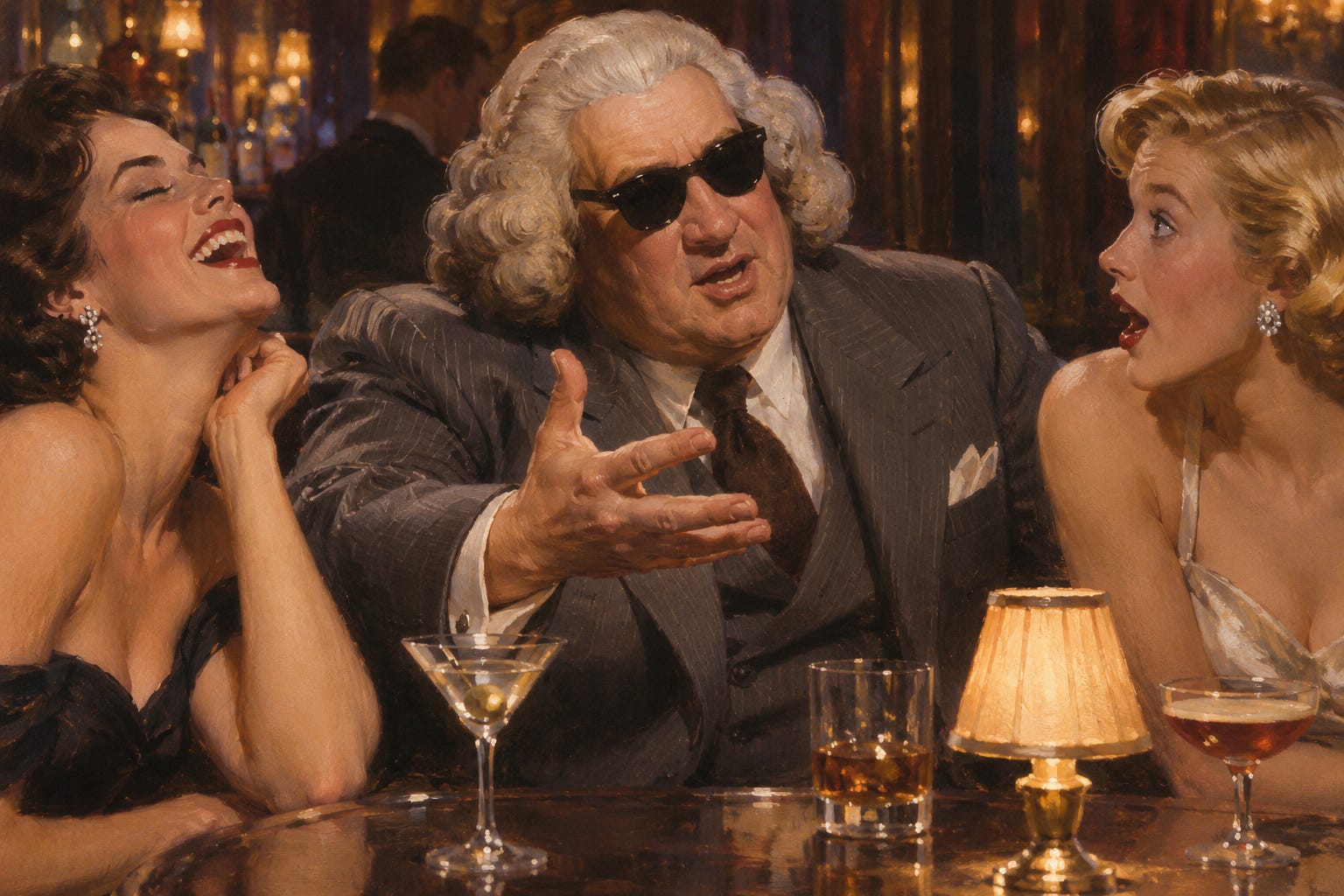
Here I present to you a work of art so fresh in truth, so bright in vibe, so deep in scope, that to skip Samuel Johnson isn’t to skip a work of philosophy. It is to skip a new and better version of yourself.

Yours,
-J
November 2nd, 2026
P.S. And why stop without an example? Without further ado, here’s Rambler #22 — an allegory about the fight between wits and scholars.
Wit and Learning Find Their Way Home
Saturday, June 2, 1750
Apollo had two children by different mothers. Wit inherited the cheerfulness and quick spirit of Euphrosyne; Learning, daughter of Sophia, grew up serious and cautious. The rival mothers taught their children contempt from infancy. Apollo foresaw the danger and divided his affection evenly, but could not uproot an animosity planted with their first thoughts and nourished every day. When they began visiting the other gods, Wit amused Venus at her dressing table by imitating Learning's solemn face, while Learning entertained Minerva at the loom with accounts of Wit's blunders and ignorance.
Their mothers enlisted supporters, and hatred grew. Both longed to sit at Jupiter's table, less to receive honor than to keep the other out; each imagined that the rival's influence depended on cheap tricks and false appearances. At last both were admitted, with the usual ceremony, among the higher divinities, and each received nectar from Hebe. That promotion ended Concord's authority at Jupiter's table. Applause passed from one side to the other as Wit and Learning disputed without rest, and victory alternated so regularly that neither would withdraw.
Wit always seized the opening. His first sallies set the entire company sparkling with what Homer calls inexhaustible laughter. Learning waited for the applause to spend itself, and for the weariness following such violent merriment to prepare the room for patience. Then she placed two of Wit's assertions side by side until they contradicted each other, or showed that he had considered too small a piece of the question to judge it. When the gods rose, they felt more reverence for Learning but more affection for Wit.
Their methods differed in everything. Wit ventured boldly; Learning examined before moving. He feared nothing so much as being thought dull; she feared the charge of error. He answered before he understood the question lest anyone suspect his speed; she hesitated over the obvious lest a hidden trick escape her. His rapid fire confused the argument; her endless distinctions tired the audience, sometimes proving what nobody disputed. Hoping to shine, Wit would risk a thought he had scarcely examined and occasionally follow a lucky idea farther than he expected. Learning rejected a new thought for fear of consequences she could not yet see, and sometimes let an advantage go unused rather than risk pressing it.
Each had a favorite prejudice. Wit loved the new because it was new; Learning revered the old because it was old. Wit could entertain listeners he failed to convince, and generally preferred entertainment anyway. Learning supported even an unsuccessful case with so many neighboring truths that her defeated arguments remained admirable. Now and then each borrowed the other's weapons. Wit toiled over a syllogism; Learning twisted her face into a joke. The results were disastrous. His solemnity had no weight, her merriment no life; in trying to win by changing character, each invited refutation or ridicule.
The quarrel eventually divided heaven. Laughing Venus took Wit under her protection, allowed him Smiles and Jests as attendants, and let him dance among the Graces. Learning stayed with Minerva and went out attended by the sterner virtues: Chastity, Temperance, Fortitude, and Labour. Wit lived with Malice and had a son, Satire, who followed his father with a quiver of poisoned arrows. Once one drew blood, no skill could remove it. He shot especially at Learning when she was busy with difficult inquiries or instructing her followers. Minerva assigned Criticism to defend her; Criticism broke the arrowheads, turned the shafts aside, or sent them back at Satire.
Jupiter at last tired of seeing heaven's peace perpetually endangered and sent both disputants to earth. Their quarrel found eager human supporters. Wit charmed the young with gaiety; Learning impressed the old with authority. Theaters went up for Wit and colleges were endowed for Learning. Each side competed in expense and display, insisting that a person must join a faction at the very beginning of life and could never expect either divinity's favor after entering the other's temple.
One set of mortals ignored them both: the worshipers of Plutus, god of wealth, neither smiled at Wit's jokes nor attended to Learning's eloquence. The enemies briefly united to send followers against these devotees. Their emissaries often betrayed them, flattering the rich before their faces while scorning them privately; once Plutus rewarded the betrayal, they even looked down upon the companions who had remained loyal to Wit and Learning.
Disgusted by these desertions, both rivals petitioned Jupiter to take them back. Thunder sounded on the right, a favorable summons, and they tried to rise. Wit spread his wings and climbed quickly, but could not see far enough to find a way through the trackless sky. Learning knew the route, but lacked the strength for more than short flights. Both tried again and fell to earth; there they understood what each lacked. Joining hands, they rose together: Wit's power carried Learning upward, and Learning's clear sight directed Wit. They reached Jupiter and grew so close that their old contest ended. Wit brought Learning among the Graces; Learning persuaded Wit to serve the Virtues. Welcome at heaven's banquets, they married at Jupiter's command; their many children were the Arts and Sciences.