

Dear H,
The irony of g--k being used to describe the Vietnamese is that in Korean, han-guk literally means "a Korean person." According to Col. Hackworth's war memoir About Face**, the term was hijacked during the Korean war and eventually transferred to the East Asians in general -- a bastardisation which stuck unfairly, and seems to have become permanent.
Asians have long complained that they "all look alike" to us, but Jennifer Eberhardt writes in Biased that people of all races have difficulty telling the difference between people of other races, and that this is a result of neurology -- not racism, as the "anti-racists" lazily suggest.
She knows this at least partially because she's black. In fact she was raised almost exclusively around black people until she was about 12. At that point her parents scraped together enough money to move her into a white neighborhood, where she could go to school with white children.
Contrary to the usual horror stories paraded by "anti-racist" authors, Eberhardt says the white people were nice. But there was a big problem. She couldn't tell one white person from the next. Who'd invited her out? Who'd given her which gift? Who was it she'd talked to last? She could catch a name and link it to clothes or the way hair was done. But this link went down the drain after friends went home and changed, and then Jennifer would confuse names again the next day. This daily mixup changed her from an outgoing and happy girl to being shy and eventually reclusive. She got over it, but it took time, and she says she isn't alone. What she experienced is what whites experience in an Asian neighborhood -- and Asians in turn experience with blacks.
She confirmed this theory while studying criminals in San Francisco, where black teenagers had been going into Chinatown and robbing the Asian women willy-nilly. Ivory-tower experts were dumbfounded about why (because experts are stupid), but the police were able to figure it out. After getting lots of arrests, perps started talking, and it turned out Asians couldn't identify robbers in a lineup. The police would round up suspects, and the Asian victim, trying to tell them apart, would get frustrated and give up. Blacks all looked alike to Asians and blacks knew it and they walked away free. The chance of getting nailed for a robbery was almost nil, unlike robbing in a black neighborhood, where a lineup for them was a fast-track to conviction.
Eberhardt says that even as children, our brains fire up when we see people of our own race. This allows us to distinguish lots of little features the other races miss. So the black criminal walks out of Chinatown free. Eberhardt doesn't know Stacey from Tracy. The Vietnamese guy gets labeled a g--k, and the people who say race isn't real are wrong. Race may not mean black men are all basketball and white men are all Beethovens*. But race is psychological and hardwired. It means we identify us and them from the cradle to the grave, and that because of it, racial harmony takes time, and a lot of hard work.
Yours,
-J
*Saul Bellow once asked, who is the Tolstoy of the Zulus? To which Ralph Wiley responded, Tolstoy is the Tolstoy of the Zulus.
Both Wiley and Bellow have a great point. Does being white make me any more like Tolstoy than being black makes anyone like Michael Jackson? Is Bellow like Albert Einstein because both of them are Jewish? I'm neither Russian nor an aristocrat and I certainly can't write like Tolstoy. But Bellow's point still stands. We can't know if the Zulus can make a Tolstoy until they make one. But in fairness to the Zulus, are we even looking? And in fairness to the white man, should we even try?
I would stand somewhere in the middle. The Zulus may have never made a real genius. But I've met lots of white people and I can say most of them are unremarkable too (and as my friend slyly put it, half of them are below average). The genius births new sounds, new thoughts, new combinations of things and men into society. But the question always remains: is he just a genetic freak, or does the wealth and structure of a society determine whether his abilities show up? In other words, if there was a genius of a Zulu, considering their state of development, would we ever be able to know it? Would we have ever discovered Tolstoy if Tolstoy hadn't been born to the upper classes -- and specifically in Russia?
In Montaigne's essays we find that Craigslist was invented by his father, and was implemented somewhat successfully in the town that he governed. But Renaissance France didn't have the internet, so the idea stopped there, and only Craig got credit for it.
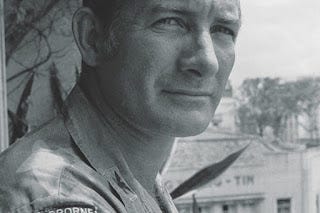
**Hackworth's memoir is notable for many reasons (read the introduction by Ward Just and the introduction, which are descriptions of Hack himself as a writer-soldier, and worth buying in themselves). But aside from the great writing, it shows a lot of men are cowards and morons before they end up being great soldiers. Something each of us needs to know before we're sent out of our parents' homes and into real life. You can fall down hard, in front of everyone, and end up saving them later.
Aside from this, About Face will make you tougher just reading it. I doubt any man can read about the freezing cold that would take your fingers off, the months without showers and what this does to your skin, the eating of raw chicken and what it does to your stomach, the drinking of machine gun cooling water out of desperation, the nights-upon-nights with almost zero sleep -- and not feel like he's living the life of a king. Hack had a way of making it all come alive. The taste of the gun water. The jumping in a bath last in line, after it had been used by 30 of your filthy best friends. The knowing you could die at any time, and the resulting desperation for getting laid and taking whatever you could get. Once you see his life you know you can get through yours -- and not just get through it, but get through it smiling. A must-read for a real man, or anyone looking to become one.