

Dear H,
Every once in a while I have the privilege to introduce, to my adoring fans, somebody who is extremely dead.
Usually, the aforementioned cadaver is just as much a surprise to me as to them. Up until last week (for instance) I had no idea S.J. Perelman existed. He had been buried, literally and figuratively, beneath a whole host of oncoming inferiors: a gaggle of second and third-rate comics who just happened to catch my eye because they had been born later, and had access to better marketers. (Or maybe, if the retailer can be summed up by his wares, we could say the marketers were worse. Not their fault, necessarily — everybody has to make a buck).
Fortunately, in the world of good literature, being dead has no affect on how you make people feel alive*. Unlike the famous skeleton at the feast, the value of communing with a great writer isn't to remind you of your own death, but to make you laugh, and gape, and wince, and cry. And in the introduction to The Best of S.J. Perelman, which was compiled in 1947, I found the following gem.
In any consideration of S. J. Perelman — and S. J. Perelman certainly deserves the same consideration one accords old ladies on street cars, babies traveling unescorted on planes, and the feeble-minded generally — it is important to remember the crushing, the well-nigh intolerable odds under which the man has struggled to produce what may well be, in the verdict of history, the most picayune prose ever produced in America.
Denied every advantage, beset and plagued by ill fortune and a disposition so crabbed as to make Alexander Pope and Dr. Johnson seem sunny by contrast, he has nevertheless managed to belt out a series of books each less distinguished than its predecessor, each a milestone of bombast, conceit, pedantry, and strutting pomposity. In his pages proliferate all the weird grammatical flora tabulated by H. W. Fowler in his Modern English Usage—the Elegant Variation, the Facetious Zeugma, the Cast-Iron Idiom, the Battered Ornament, the Bower’s-Bird Phrase, the Sturdy Indefensible, the Side-Slip, and the Unequal Yokefellow. His work is a museum of mediocrity, a monument to the truly banal. What Flaubert did to the French bourgeois in Bouvard and Pecuchet, what Pizarro did to the Incas, what Jack Dempsey did to Paolino Uzcudun, S. J. Perelman has done to American belles-lettres.
It is customary to palliate the shortcomings of certain eminent men by pleading their physical drawbacks. Dostoievsky’s epilepsy, Beethoven’s deafness and Milton’s blindness have all been served up on occasion to explain their vagaries. The same must be done for S. J. Perelman, except that he has labored under a far greater handicap. Extraordinary though it may seem, his entire output over the past two decades has been achieved without benefit of brain. The plain medical fact which cannot be blinked (and if we are to blink it, we must accept the consequences) is that his skull is little more than a hollow gourd, a mere bony knob on which reposes a battered Herbert Johnson hat. How he contrives to fulfil the ordinary obligations of everyday life — to get to his office, philander with his secretary, bedevil his wife, and terrorize his children — is one of those mysteries of science like the common cold or mixed bathing.
The rest of his physique is even less prepossessing. Under a forehead roughly comparable to that of the Javanese or the Piltdown Man are visible a pair of tiny pig eyes, lit up alternately by greed and concupiscence. His nose, broken in childhood by a self-inflicted blow with a hockey stick, has a prehensile tip, ever quick to smell out an insult; at the least suspicion of an affront, Perelman, who has the pride of a Spanish grandee, has been known to whip out his sword-cane and hide in the nearest closet.
He has a good figure, if not a spectacular one; above the hips, a barrel chest and a barrel belly form a single plastic unit which bobbles uncertainly on a pair of skinny shanks. In motion, the man’s body may best be likened to a New Bedford whaler in the teeth of an equinoctial gale; in repose, it is strongly reminiscent of a giant sloth. In point of fact, from what small exterior evidence we possess, it would appear that he has modeled himself closely on that luckless animal. A monstrous indolence, cheek by jowl with the kind of irascibility displayed by a Vermont postmaster while sorting the morning mail, is perhaps his chief characteristic. Small wonder that he should have chosen for his book-plate that significant Revolutionary emblem, a crouched rattlesnake above the terse injunction, “Don’t Tread on Me.”
With this, the funnest (and maybe finest) introduction I've ever seen to any man’s work, I read on, and was kept totally amused. In the following pages I found typos, formatting issues, racial slurs, cracks at oversized women, and, in some places, an almost-incomprehensible dialogue that was worth reading two, three, even four times over — simply because it was so fun. And why did I buy this gem? Because of an obscure comment made by Woody Allen, to the effect that “nobody was ever funnier than S.J. Perelman.” High words from a man who, as a screenwriter, not only "holds the most wins (3) and nominations (16) for the Academy Award for Best Original Screenplay,” but adopted a Korean girl and then proceeded to marry her. Republicans have yet to decide whether these facts are signs of Allen’s comedy or criminality. Democrats will let Jews get away with almost anything except The Holy Land.
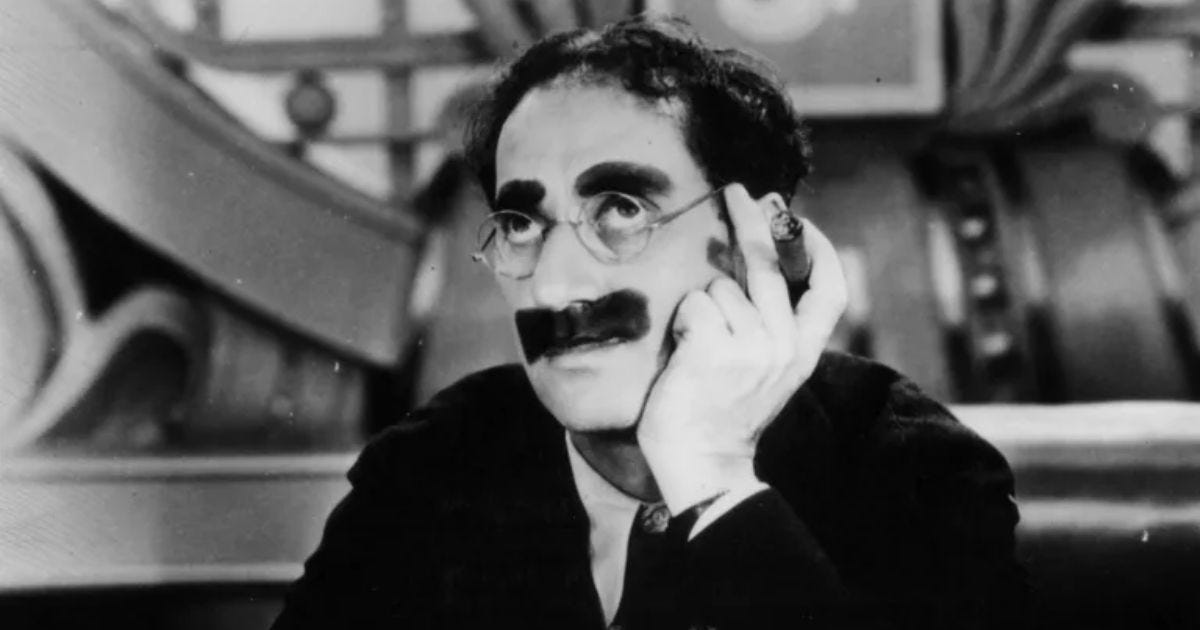
Anywho, since picking the book up I have yet to be disappointed. The jokes land, even though he sometimes makes you consult a dictionary. And the words are strung together so well, and sparkle and shine with such style and wit, that he’s worth reading even when he’s being matter-of-fact. He penned screenplays for the Marx Brothers, and wrote side-by-side with E.B. White, over two decades, for The New Yorker. (If you don’t know why E.B. White matters, pick up his essays on Amazon).
I have no idea what to expect next — for instance, whether the following short stories will embarrass me for publicly sharing my hope in them. And who knows? Maybe I’ll just be embarrassed for sharing Perelman. Maybe his Wikipedia, like Woody Allen’s, will say he molested some of his relatives — possibly two uncles, and a grandma. But thus far Perelman is a reminder that like Oscar Wilde, The Princess Bride, “We are the World” and that poem on the Statue of Liberty, the best jokes never go stale.
You can buy The Best of S.J. Perelman for 99 cents on Kindle.
Yours,
-J
July 28th, 2026
*Speaking of the dead giving us a new lease on life, Shakespeare writes, in his Sonnets,
THAT time of year thou mayst in me behold
When yellow leaves, or none, or few, do hang
Upon those boughs which shake against the cold,
Bare ruin’d choirs, where late the sweet birds sang.
In me thou see’st the twilight of such day
As after sunset fadeth in the west;
Which by and by black night doth take away,
Death’s second self, that seals up all in rest.
In me thou see’st the glowing of such fire,
That on the ashes of his youth doth lie,
As the death-bed whereon it must expire
Consum’d with that which it was nourish’d by.
This thou perceiv’st, which makes thy love more strong,
To love that well which thou must leave ere long.
—
BUT be contented: when that fell arrest
Without all bail shall carry me away,
My life hath in this line some interest,
Which for memorial still with thee shall stay.
When thou reviewest this, thou dost review
The very part was consecrate to thee:
The earth can have but earth, which is his due;
My spirit is thine, the better part of me:
So then thou hast but lost the dregs of life,
The prey of worms, my body being dead;
The coward conquest of a wretch’s knife,
Too base of thee to be remembered.
The worth of that is that which it contains,
And that is this, and this with thee remains.
— two stanzas I read four times to understand, and another four times to savor.
**The idea that every woman in Woody Allen’s vicinity was in danger is an overstep. He writes, in his memoir Apropos of Nothing,
In Mom’s defense I have to say [she] was a wonderful woman; bright, hardworking, sacrificing. She was faithful and loving and decent but not, let us say, physically prepossessing. When I said years later my mother looked like Groucho Marx, people thought I was kidding. […] Mom had five sisters, one homelier than the next, with Mom arguably the homeliest of the swarm. Let me put it this way: Freud’s Oedipal theory that all us men unconsciously want to kill our fathers and marry our mothers hits a brick wall when it comes to my mother.
After he married Soon-Yi, we owe him thanks for the clarification.