

Some people are worried about the difference between right and wrong. I’m worried about the difference between wrong and fun.
-P.J. O’Rourke
Dear M,
I'm sorry to report this, but despite obviously being a philosopher, I've been banned from several big Facebook groups about philosophy.
We got off to a good start, but eventually they found out my positions on race and gender and that was pretty much the end of it. Their admins wanted to talk about what “the point of life” is, or which people you’d run over with a trolley (my answer is currently “the admins”), or whether we can know reality; and I decided I already knew reality is real and I wanted to make fun of it. Or rather the people inside of it. And by this I meant their sacred cows and pretensions.
To me this means they’re missing the whole point. Philosophy (proper) is too clean and narrow and technical to nerds — almost too mechanical, like pulling apart a clock. And that makes it something almost work-safe and controllable. But in my perspective philosophy is more like sex: something which can easily build a family or blow one up; a Catholic institution or a hotbed of rebellion; serious and comical at the same time; wild, and fertile, and messy, and organic. And if you tell people the truth it makes you feel kinda naked.
This makes me wonder how philosophers got classified with the invalids and video-gamers. In my sight philosophy makes a man more robust, and likely to get himself laid — or maybe socked in the nose. And if somebody throws a punch, philosophy should make you ready to dodge and throw one right back. How should a man take a punch, by the way? And do you think he deserved it? These are good topics for a philosopher — not Plato's stupid cave allegory, or the difference between “noumena” and “phenomena.”
In this sense it's more an art form or a dance than an arm-chair profession: a willingness to grow and tinker around; to try something better and push yourself harder; to smell, and see, and touch the beautiful, the electrical, the inexpressible — in some cases the forbidden. So far from being white-collar, philosophy should get your hands dirty. It should be brave, and charming, and manly, and true. It should be the kind of talk that gets people to stop and listen at a party, even if they can’t look like it. Even if they’re afraid to join in.
So you can read Schopenhauer’s essay on the senses if you want to. I’d rather hear his ideas on the sexes. And I don’t really care about Plato's “forms" or Aristotle’s metaphysics either. I want to hear all their statements on rhetoric, and marriage, and music, and politics — the more honest and the less modern the better. I want a variety of takes on living: some good so I can steal them, some bad so I can make fun of them. The last thing I want is a question of whether life is worth living. We’re all still alive, so I want a treatise on whether eggheads who ask this are worth kicking.
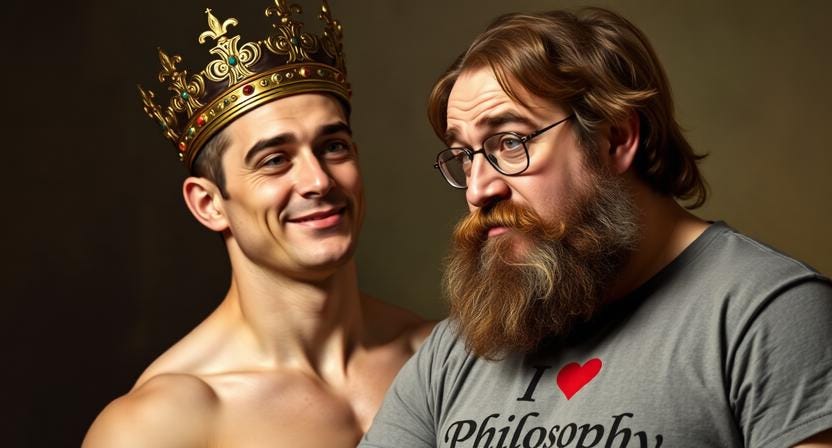
Thus a good question for a philosopher (in my opinion) is, is it ever okay to laugh when somebody dies*? Is the Sermon on the Mount really morally superior — or if we took it seriously, is it dangerous to society? If men and women are equal, where are all the woman geniuses? Shouldn’t you admire your therapist before accepting their therapy? Is “doing things” a rejection of the sovereignty of God? Is folly necessary to be happy? Should you be gracious on Easter or fight for a good cause? Why are secular heroes more interesting than saints? Are emotions the antithesis of reason — or the basis of it? What kind of woman is the most dangerous to marry? If the Holy Spirit inspires people, why is "The Devil's Music” so much better? And despite its critics, is it even possible to get rid of capitalism?
I believe many of these subjects are what others would call politics or polemics or morals or religion; but to me, they fall within the range of philosophy, and the nerds who style themselves “philosophers” don’t like that. They think philosophy is a sanitized side-gig to kill time. I prefer Socrates’ position: that philosophy exists to save lives. But eventually, this means people try to kill you. And then Socrates will sit on death row talking about that too.
Speaking of which, when the city of Athens condemned Socrates to die, Socrates shot back, “and nature has condemned them.” And when his wife told him “you die unjustly” he shot back, “would you prefer that I die justly?”
Two quips worthy of the name philosophy.
Yours,
-J
*There’s been some debate this year about whether you can laugh and say F ‘em when somebody dies. To quote Charlie Kirk, you can tell a lot about a person by the way they deal with somebody’s death. And he’s right: you really do learn a lot.
For instance, what do you do about a man who celebrates Charlie Kirk’s death? That means if he disagrees with you he’d shoot you, and I think we have a right to take him seriously. But what do you do about somebody who won’t laugh at an actual boob? Am I supposed to cry when a grown man sticks his hand in the tiger’s cage and gets bit? Am I supposed to start a GoFundMe when somebody attacks the cops and gets shot? How am I supposed to feel when a college-educated white woman, to prove racism is bad, goes hiking alone in Pakistan and ends up getting murdered? Do I have to feel bad when a rando fights for legalized drugs, and then gets ran over by somebody high on acid and chasing a leprechaun?
The whole point of social liberalism is to debate the possibilities of cause and effect; and to say we can’t laugh at idiots, or even that saying “I told you so” is mean-spirited, or uncouth, or just plain wrong, undoes the whole point. Especially when somebody dies**.
There are lines to be drawn here like with anything else, and those can be reserved for a more respectable essay. But to censor the irony of Charlie Kirk’s death is to completely miss the whole gist of Charlie Kirk’s life. If Charlie said we ought to keep guns, repeatedly, in public, and then gets killed by the armed psychotic Democrat the Democrats warned us about, I think Democrats have a right to point that out. It’s one reason Democrats want us to ban them.
Do I think their arguments are good? For the love of Pete, fuck no. We need guns to protect ourselves from people like Democrats. What I’m saying is that if you have a policy, and somebody dies because we didn’t vote for the policy, you have a right to say “this is why we need the policy.” Even if the policy sucks. And even if the man who wants it is a dick. This is bare-minimum freedom of speech, and without it, nobody has a right to debate anything.
This being said, there’s only one kind of man who sincerely respects folly — and that is the person who practices it. Solomon says, The Lord laughs at the wicked, for He knows their day is coming. I would argue that sometimes it’s godly to laugh because a fool’s day already came. The big question isn’t whether we can laugh, but whether we’re okay with being laughed at. Here the Golden Rule is a double-edged sword — and we’re never quite sure whether it stings worst when the laughter is just or unjust.
**The truth is, when somebody dies in a stupid way I’m not always sure whether I’ll laugh or I’ll cry.
When I was young I thought of people as individuals. But now that I have kids sometimes I see people as a series of relations. Thus when the founder of Segway was riding his fruity little scooter and texting friends and drove off a cliff, my first instinct was to laugh. But then I think of him as somebody’s son and it isn’t so funny anymore.
And this is the whole point. Tears and laughter all come from the same place. Something went horribly wrong and it hurts — but if we can isolate the absurdity and the pain from the man, from his kids, from his parents, driving off a cliff while texting is a joke. The closer it hits the worse that it gets. The further off, the funnier. Most of the time, anyway.
Thus sometimes we feel terrible about laughing. And sometimes, when the behavior is so bad that we don’t want it anywhere near us or our kids, we couldn’t give less of a shit. It’s either us or the fool. So we use laughter as a weapon — as a lesson. And we hope the wordless sermon sticks.
P.S. Going back to "philosophy proper," the proliferation and establishment of what’s known as existentialism can be blamed mainly on one thing: the disappearance of God from the public consciousness.
Once God was out of the picture everyone asked, “what’s the point?” Which is why, in the age of Christendom, we got so many more interesting (and I would argue even more dangerous) philosophers. The ancient man was building on an unshakable foundation. The modern man doesn’t know whether to build at all. He’s trying to undo a negative, instead of doing something truly positive. The center of his existence isn’t really “how should I live,” but “why should I?”
Another angle on these weak-ass “philosophers” is more telling. Nietzsche writes, in the preface to The Joyous Science, about how he was deathly sick for a while, and how health — of all kinds, you might say — determines your whole view of life.
Assuming that he is a person, of necessity he also has his own personal philosophy: there is, however, an important distinction to be made. In some, their deficiencies philosophize, in others, their wealth and strength. The former have need of their philosophy, whether as support, reassurance, medicine, deliverance, exaltation or depersonalization; the latter merely regard it as a fine luxury, or at best the voluptuousness of a triumphant gratitude which in the end must inscribe itself in cosmic capitals on the heaven of ideas. [...]
After such self-interrogation and self-examination one comes to view all that has ever been philosophized with a keener eye; one more readily discerns the involuntary wrong turns, side streets, resting places and sunny spots of thought to which suffering thinkers, precisely as sufferers, are led and misled: from now on, one knows where the sickly body and its needs unwittingly urge, prod and entice the intellect — to sunlight, tranquillity, gentleness, patience, medicine, balm in some sense. Every philosophy which puts peace above war, every ethic with a negative conception of happiness, every metaphysic and physic that knows an end, a final state of any kind, every predominantly aesthetic or religious longing for some means to get away from, outside of, above or beyond the world, all these raise the question of whether illness has not inspired the philosopher. […] In all philosophizing so far it has not been a question of ‘truth’ at all, but of something else — namely of health, futurity, growth, power, life.
And that's the difference between me and the other modern philosophers. I don’t view this as just a match of good versus evil, or truth versus lies. I am robust, and handsome, and religious — and thus dynamic. And I’m up against the godless, the sexless, the unhealthy and the undisciplined — the dying.
It would be interesting to hear what a real live philosopher would say about something like this.
Is it just the musings of the paranoid ? Or perhaps a premonition of the future by people who are direct descendants of a gal named Cassandra ?
https://www.theburningplatform.com/2026/04/28/kill-switch-of-freedom/