

Dear T,
Bion was such a sharp and controversial philosopher that people got tired of arguing with him and started making fun of his parents. It got so bad that he had to release a statement about it.
“My father was a freed slave,” he said. “He sold salted fish, and was so unremarkable that his crowning features were the brands on his face — a keepsake from his old master’s severity. My mother was the kind of woman you’d expect to marry such a man: straight out of a brothel. Then my father, who cheated the tax collector, was sold with our whole family. I was bought by an orator because I was young and charming, and when he died, I inherited all he had. I burned his writings, scraped together everything I could, came here to Athens, and took up philosophy. This is the blood and pedigree I claim, so let Persaeus and Philonides quit talking about it. You can judge me by my own merits.”
With that out of the way, everyone was forced to judge him by his own merits. He took the lowest seat* as Jesus later commanded, and was able to get on with his career of harassing the other philosophers.
We don't have any of his books, but his one-liners were fun and useful enough to pass around for two millennia. When someone asked him who has the most anxiety, he said “whoever wants to be the most happy.” He used to call old age “the harbor of all evils” since all of them like to take refuge there. Noting who gets hit with gossip and slander the hardest, he called fame the mother of all accusations. He called beauty “someone else’s good” since everybody sees you except yourself; and, knowing it takes money to make money, he called wealth “the sinews of success.”
He said not being able to bear evil is itself a great evil. Both he and Antisthenes are credited with the famous line, when asked whether to marry, if she’s ugly you’ll have to bear her; if she’s pretty you’ll have to share her. And in an age of slavery, prostitution, and conquest, he stated that it is better to gratify someone else with your own beauty than to pluck that of another; for the latter hurts both your body and soul.
Predating Jesus, he said the path to Hades is easy to travel — at any rate, men set off on it with their eyes closed. He said of a rich old miser, this man doesn't own property — property owns him. And recognizing the importance of humility, he used to say that a big ego is a big obstacle to progress.
Mirroring today’s there are old soldiers and bold soldiers, but there are no old, bold soldiers, Bion said that in youth men are brave, but in old age they excel in wisdom. He said the downside of being a miser is that you think your property belongs to you, but you get no more benefit from it than if it belonged to somebody else. He said wisdom surpasses the other virtues like sight surpasses the other senses — true, since the other virtues, applied the wrong way, are just as bad as vices. And he used to say that nobody should disparage old age, since everybody is trying so hard to reach it.
One day he saw a slanderer scowling. He said, “I can’t tell whether something bad happened to you or something good happened to somebody else.” And another time, when he was a fellow passenger with some worthless scoundrels, his ship was overtaken by pirates. “We’re done for if they recognize us,” his fellow sailors said — referring to their bad records. Agreeing with them, he comically shot back, “and I too if they don’t recognize me” — a double play on the idea of ransom and the importance of keeping good company.
What exactly was his philosophy? Nobody's quite sure, since he switched schools too many times to say — the mark of either a true fool or a real maverick and a seeker. At first he followed Plato’s Academy. Then he went for the cynicism of Diogenes. Then he followed Theodorus the atheist — a man known for mocking the gods, and being versatile in all kinds of sophistry. Then he followed Theophrastus, a follower of Aristotle. We don’t know whether he was a believer in any of them or just trying them out or mining what he could from them. But we know he was a master of all the different styles and had a great time making fun of everything.
His own style was theatrical, and he liked to use common language to jab at big subjects. His tastes were extravagant, and he loved to move from one city to another — sometimes throwing himself a parade on the way there. He was a gay horndog both for fun and to make allies. An extremely selfish man, he was big on the idea that “friends share property in common.” For this reason, even though students crowded into his lectures, not a single person ever chose to be his disciple.
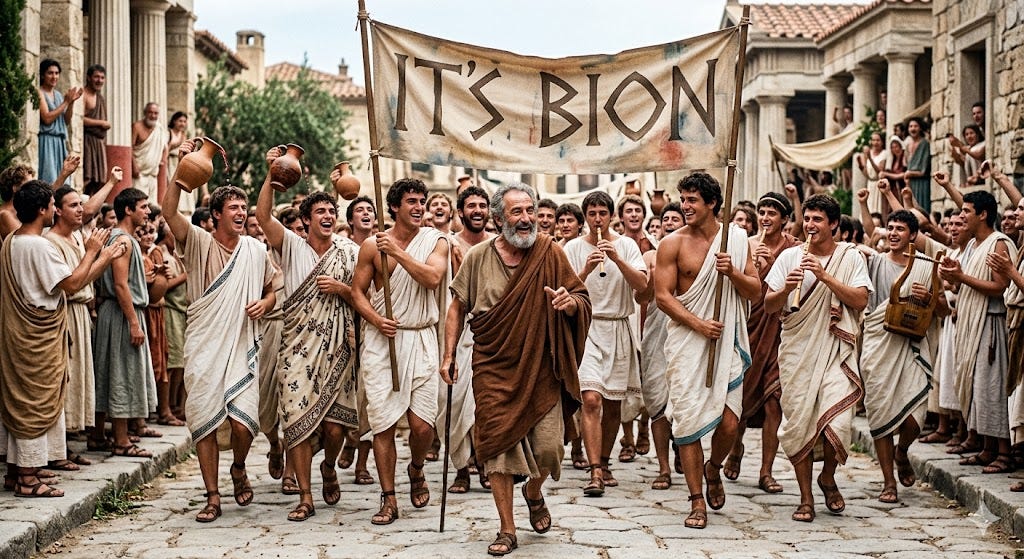
He loved making fun of “the gods” — which is half noble and half crazy. To make jokes about the false myths and doctrines of the plebs is a good time. To make light of the magic and mystery of the universe is a mistake. Confounding one with the other and being “an atheist” doesn’t make you smarter than everyone else. It makes you confuse the absurdities of everyone else with the real majesty of God.
Which he found out by the end of his life, because he got sick. At that point the people of Chalcis (the place where he died) maintain that he got superstitious. He started reaching out to the gods any way he could, buying amulets and repenting of his irreverence and misdeeds. Because he made fun of everyone and "shared” all their stuff, nobody cared for him when he got sick, and he was in a state of absolute ruin — until some other wiser philosopher sent him two servants. His greed burned all his bridges. His extravagance blew all his savings. His pride led him to all kinds of embarrassment. Proof (like with Solomon) that teaching wisdom and living it are two completely different art forms.
In the end, Bion’s life proved two things. First, that the middle years, when we're healthy and strong and successful, are fleeting — a mere season. And we need to save up money and raise children and good-will for the end of it**. As another “great philosopher” put it,
When I was younger, so much younger than today
I never needed anybody's help in any way
But now these days are gone and I'm not so self assured
Now I find I've changed my mind, I've opened up the doors
And second, that you can make fun of religion all you want; but you came from Someone and you’re going back to Him whether you like it or not. So before cracking too many jokes, make sure you distinguish between Him and the gullibility, the hypocrisy, and the misplaced zeal of His goofy-ass followers.
Yours,
-J
June 9th, 2026
*Taking the lowest seat (as I’ve mentioned before) doesn’t just mean putting yourself in last place forever. The goal is always to finish in first.
What, after all, is a great businessman? Someone who knows how to deliver the goods. And what is a great leader? Somebody who can get you somewhere you want to go. What is a great doctor, a rock star, a lover, or a sage? Somebody who knows how to fix you, how to make you feel, how to make you shine. To “be somebody” you have to first do something. And the key is, it has to be for somebody else. The very neediness of man is the source of our greatness.
As the poet Rumi put it,
Every craftsman searches for what’s not there to practice his craft.
A builder looks for the hole where the roof caved in.
A water carrier chooses the empty pot.
A carpenter stops at the house with no door.
Workers rush toward some hint of emptiness, which they then start to fill.
Their hope is for emptiness, so don’t think you must avoid it.
Emptiness contains what you need!
Dear soul, if you weren't friends with the vast nothing, why would you always be casting your net into it, and waiting so patiently? This invisible ocean has given you such abundance, but still you call it “death” — that which provides you sustenance and work.
Does this mindset of looking for needs and filling them make you a leader or a servant? The answer is both — but one has to come before the other. And if you get it backwards, you finish in last.
**Regarding being famous and dying alone, Samuel Johnson writes in The Rambler,
It is not possible to be regarded with tenderness except by a few. That merit which gives greatness and renown diffuses its influence to a wide compass, but acts weakly on every single breast. It is placed at a distance from common spectators, and shines like one of the remote stars, of which the light reaches us, but not the heat.
The wit, the hero, the philosopher, whom their tempers or their fortunes have hindered from intimate relations, die, without any other effect than that of adding a new topic to the conversation of the day. They impress none with any fresh conviction of the fragility of our nature, because none had any particular interest in their lives, or was united to them by a reciprocation of benefits and endearments.
This is really much simpler than it sounds. If you want to be great to somebody — to be adored, and idolized, and missed — don’t be the President. Just be a good dad.