

Dear M,
I don't read many Christian books these days, but I was hooked from the first passage of Nik Ripken's The Insanity of God. It begins,
My real name is not Nik Ripken. My reason for writing under a pseudonym will become apparent soon enough. Rest assured, my story and the people who appear in it are very real. Many of these people are, to this day, in real danger. It is their identities that I want to protect. For this story, I have changed my name and I have changed their names too.
With that I bought it and found it to be one of the most moving and beautiful books I've read in a while.
Why? Simply put, it’s hard to read the New Testament and then go to church and believe you're not being featured on a prank show. Nobody claims a direct word from the Holy Spirit, and if they do, you wonder if they're pulling your leg or clinically insane. Nobody has been raised to life or struck dead by an Apostle. In fact there aren't any Apostles. There aren't any small-c communists either. Quite frankly we don’t trust each other enough for pooling cash. And the idea of hearing about another church in another city and being earnestly concerned about their welfare just because they exist is weirder than hearing somebody try to speak in tongues. In short, it's impossible to look around you (and especially in the mirror) and not wonder, “are we a bunch of phonies?”
The answer, as we all know, is kinda*. But reading this book convinced me that the cult-like first century church exists today (somewhere else), and that it’s every bit as beautiful, profound, and dynamic as Peter and Paul working miracles in the Book of Acts.
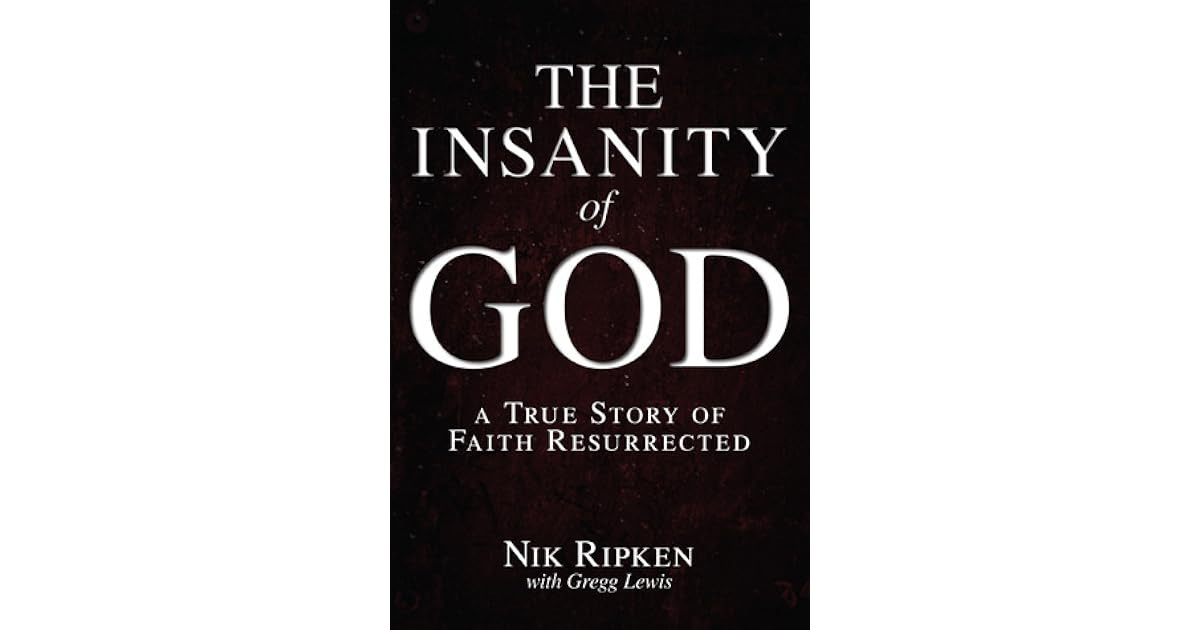
Not that this is Nik's doing. The irony of this book is that Nik's own ministry to Africa was a failure — as he tells us himself. It left him with so many questions about God that he was forced to retreat, tail between his legs, and this led him to meet real saints under fire around the globe. The substance of this book is their stories, and the stories of God working miracles all around them. I really strongly recommend it — especially if you're wondering how Paul raised a guy from the dead, and the closest thing you've ever seen is the impression of the dead guy.
(Hats off to L______d Orthodox Presbyterian Church, where a man in the back row would fall asleep, on cue, at the start of every sermon).
One of the things I love about The Insanity of God is that Nik himself isn't a hero, and he’s also not much of a writer or a thinker**. I’m not even certain he was “called” to Africa for Africa's sake.
Supposedly called by God’s voice while working at night in a factory, Nik starts reading his Bible. He finds Matthew 28 and believes God told him to go out in the world and preach the Gospel. He gets the hots for a preacher's kid, and she can’t marry him unless he agrees to go to Africa. So voila — Nik discovers his calling to Africa and packs his bags. Whether a calling is real or imagined, once whoopie gets thrown into the mix, it’s almost impossible to stop a guy. To confirm this, just ask anyone named Mohammed****.
Nik starts out in Malawi, where the Africans are receptive to the Gospel but malaria almost kills his family. Then he heads to South Africa where the angry blacks want to kill his family. Then he heads to Kenya, where he leaves his family and almost gets killed by Somalians.
About half the book is spent in Somalia during their civil war in the 90’s, and the reading here is really gripping. He was blocks away from Blackhawk Down and could actually hear all the gunfire. He saw villages that were massacred, children starved to death, and some of his aid efforts backfire in murder. One time he airlifted bags of corn and crippled a whole bunch of Somalians when the bags got parachuted and the crowds tried to catch them. During the whole thing he saved lots of lives and zero souls. In fact he felt compelled to keep his mouth shut for people’s safety. And he saw so many horror stories, many recounted vividly, that he wonders if God's actually losing the war against evil.
The funny part is, whether God actually called Nik to go to Africa is anybody's guess. He says God told him to in Matthew 28, where Jesus says go ye into all the world. Nik never considered that this instruction was to the apostles. He never considered that if this applied to everyone, no convert could ever live in his home country — as most clearly did in the New Testament. Nik heard he was to serve his “neighbor,” so he booked it as far from his neighbors as humanly possible. God called me to Africa, he said. And Africa screwed him over big time because Nik never heard of the word “context.”
Eventually it's too much for him and he asks, how am I supposed to spread God’s word, when telling people about Christ will get my relief workers killed? — a question that keeps him up at night. He’s apparently ready to die himself, but getting his friends killed makes him queasy. So he decides if Africa’s going to work he’s going to have to find out how Christians survived in Soviet Russia.
That's when the book takes a turn. Nik’s plan at this point is to teach African Christians how to survive. But the Soviet Christians teach him how to throw everything away. There are so many beautiful stories of God making people come alive (please read them), and these people sharing Christ no matter the cost, that what Nik ends up realizing is he has it all backwards. What keeps the Gospel alive isn’t people learning to save things. It’s that the Gospel is so beautiful and essential that it stays alive because people are willing to lose things.
He goes to China and Ukraine and finds the same thing. Everywhere he looks, God is working miracles. And he finds that what believers pray for isn't even that persecution stops. They pray that they can get through persecution worthily.
But he finds something even more profound. When persecution does stop, the church ends up killing itself. Fathers stop leading their children and neighbors in home church. The Bible becomes common and forgotten. Believers take one another for granted and don't look out for each other as much. Miracles go away, along with heroics. The church under fire is courageous, ingenious, sincere, gracious, pure, and obedient. The church during peacetime is lazy, greedy, silly, insincere, and cowardly. Great virtue requires great evils, and the presence of danger makes heroes*****. The establishment of safety? Makes loafers.
Nik writes in the preface,
This is my own, true account of a long and personal journey. I share this story not as a great heroic adventure; in fact, much of the time this pilgrimage has felt to me like an endless bumbling, stumbling, wandering, feeling-my-way-in-the-dark ordeal. This is a story with a clear beginning—and an uncertain ending.
But to me the ending isn't so uncertain. And we find that Nik himself isn't a failure. God did call Nik and let Nik go to Africa — to fail. The failing led him to ask questions. The questions led him to China. And the Chinese showed him that God is alive and well — and that nothing, nobody, nowhere is capable of stopping Him.
Except maybe (for the moment) Somalia.
Yours,
-J
*There’s a passage in the book where Nik’s talking to Chinese believers and finds out that prison, to them, is the equivalent of going to seminary. It’s where they prove themselves fit for service and get to spend serious time learning with veteran believers. In fact Chinese Christians are so beefy that what looks like a tragedy to us is considered a promotion******.
It was then I realized something about the following lyrics.
Riches I heed not, nor man’s empty praise
Thou my inheritance now and always
Thou and thou only first in my heart
High King of heaven, my treasure Thou art
I used to think these lyrics were dishonest, but now I realize they're good. They’re just usually sung at the wrong time. In the end, the only safe place to sing them isn’t church, but prison. It’s the only place you can be sure you really mean it.
**Nik Ripken's The Insanity of God can be safely called a work of anti-gonzo journalism. In gonzo, the journalist gets hired to do a story on some dramatic thing — say, the Kentucky Derby, or a civil war in Lebanon. And what usually happens is that the journalist is so crazy and hilarious and fun that the subject becomes a background and the writer ends up being the centerpiece. If you’ve ever read Fear and Loathing in Las Vegas or Holidays in Hell you know what I’m talking about. Hunter S Thompson and P.J. O’Rourke won’t win any prizes for informing anyone about anything. But do we have fun? You bet your ass we do.
Nik Ripken is the polar opposite. His writing gets bad at times — which is hilarious, because it looks like he worked with a co-writer. His ideas get boggled. He isn’t funny (at least not on purpose) and he isn’t witty either. The book’s title is eye-grabbing — but less like a thunderbolt or a cathedral and more like a baboon's ass. For goodness's sake, he named himself freaking Nik Ripken — like Snake Plissken without the eye patch.
But God uses him to chronicle people who either couldn't or wouldn't chronicle themselves. As such, he ends up writing us the sequel to the Book of Acts we desperately needed. His banality allows the real heroes to stand out more. His style turns the focus away from him and onto others.
Nobody thanks Saint Luke for his wit or his charm or his insights or his style either. They thank him because he told us what God did. I don't think Nik Ripken does as good a job, but he works along the same lines. What we needed wasn't a literary genius or a philosopher, but a plain-spoken failure-of-a-country-boy to just tell us all the details — because there were so many of them, and they spoke for themselves.
Mother Theresa, on the other hand, needed a smart and literary chronicler like Malcolm Muggeridge. Her works were small and unsensational. What we needed was to be introduced to her soul — and we got the tiny masterpiece Something Beautiful for God.
***Nik's “failed” calling reminds me of Alan Watts’s story about an old Chinese farmer.
Let’s say this old farmer lives with his son. They only have one horse, but that horse runs away; and the farmer’s friends stop by that night and the farmer tells them about the horse and the friends say, boy, that's terrible news. And he says to them, well, maybe.
The next day the horse comes back with seven other horses, and the farmer’s friends hear about it and they say, "what great news!” And the farmer says again, yeah, maybe.
The next day the son took one of the new horses out to train it, and the son falls off the horse and breaks his leg. And the farmer's friends stop by and say “what horrible news!” And the farmer says again, well, maybe.
The next day the conscription officer stops by and says they're taking every able-bodied young man away for the army. But the young man has a broken leg, so they leave him behind. And when the farmer's friends stop by that night they say, "well that's great news!” And the farmer says, well, maybe.
The point of the story is simple. This universe and the God who made it are so complex that you can never tell whether your tragedy is good luck or your good luck is a tragedy in the making. A Buddhist like Alan Watts may not be so sure. A Christian is — and at his best he knows that whatever happens, it ends better than we planned for.
I believe this is why Christians can take Christ’s crazy commandments seriously. Faced with a universe and a God beyond our comprehension, we have a choice: we can take life on with our own hands, or we can place ourselves in His. Americans take baby steps, if we can find the faith to take them at all******. Thus we find ourselves wading lazily in the shallows. The Chinese are thrown into the deep end of the pool — and we get to see them swim.
****When I say ask anyone named Mohammed I’m obviously referring not only to the recurring theme of Islamic history — that you get to kill off infidels and hoard all their ladies — but to the gold-prize 72 virgins in heaven: proof that at least one person knew how to paint eternity better than gold streets and endless hymns. A little art goes a long way.
*****We may not all be wankers. I submit the possibility that outside of great dangers, some of us might just be heroes in utero.
Whether we are or not is anybody’s guess. A man without a chance to prove himself is always a giant question mark.
******Every man needs to see real suffering frequently or he’ll turn into a giant weenie. Thus I encourage every 9-to-5-and-Netflix Christian complaining about persecution in America to shut up and read this book. Like Hackworth's About Face or The Gulag Archipelago, it might not make you tougher, but it will shame you into not complaining — which is the next best thing. And that's just for the laymen. For pastors, it will encourage them to shut up with their sermons about anxiety and depression: two subjects which make history readers roll their eyes, and retired Marines want to throw up.
******The great paradox of Christian missions is this. You see a place that's a godless mess and you want to fix it. But once people get converted and the place gets cleaned up, some holy man shows up and shames people for not throwing it away. If it’s a disaster you're supposed to save it. If it gets saved you’re supposed to leave it.