

Dear T,
What does a man write about at the end of the world?
In the last month we got a bleak view of the near future — and probably the distant future too. With the overwhelming election of leftists we see open borders on the horizon; junkies and lunatics and race rioters on a rampage; babies cut up right before they’re born; the possibility of mandates for quack medicines and poisonous vaccines; the suppression of free speech on social media by the CIA and the FBI; the mass-election of judges who not only invent laws, but punish the upright and liberate the guilty. We expect the election system to be rigged worse, and for our own government to import hordes of Africans and Islamists.
Everything seems unnatural in this strange chaos of frivolity and ferocity, with all sorts of crimes jumbled together with all sorts of follies. In viewing this monstrous tragicomic scene, the most opposite passions necessarily follow and sometimes mix with one another in the mind: contempt and indignation, laughter and tears, scorn and horror, each by turns.
—Edmund Burke, Reflections on the Revolution in France (modernized)
Thus a writer has to ask himself: do I just join in with the chorus of doomsayers? Is there something I can add to the obvious, to the depressing, to the funeral dirge of a whole civilization? Or do I do what I always aimed to do? To sharpen some barbs? To Christen a path? To hammer and chisel at what’s actually mine?
Like the collapse of the Roman republic led to the Stoic revival, every man must ask himself what's his and what isn't; which things are real and which are imaginary; what he can change and what must change him. And I’m reminded that I was always a canoe in the Pacific anyway: that my essays, beautiful as they are (to my mom), are virtually insignificant in the chaos and jumble of the world1. And does that make them any less important — or less fun? In an unending barrage of TikTok tragedies, if I cried every time something went wrong, I’d probably never have a chance to laugh.
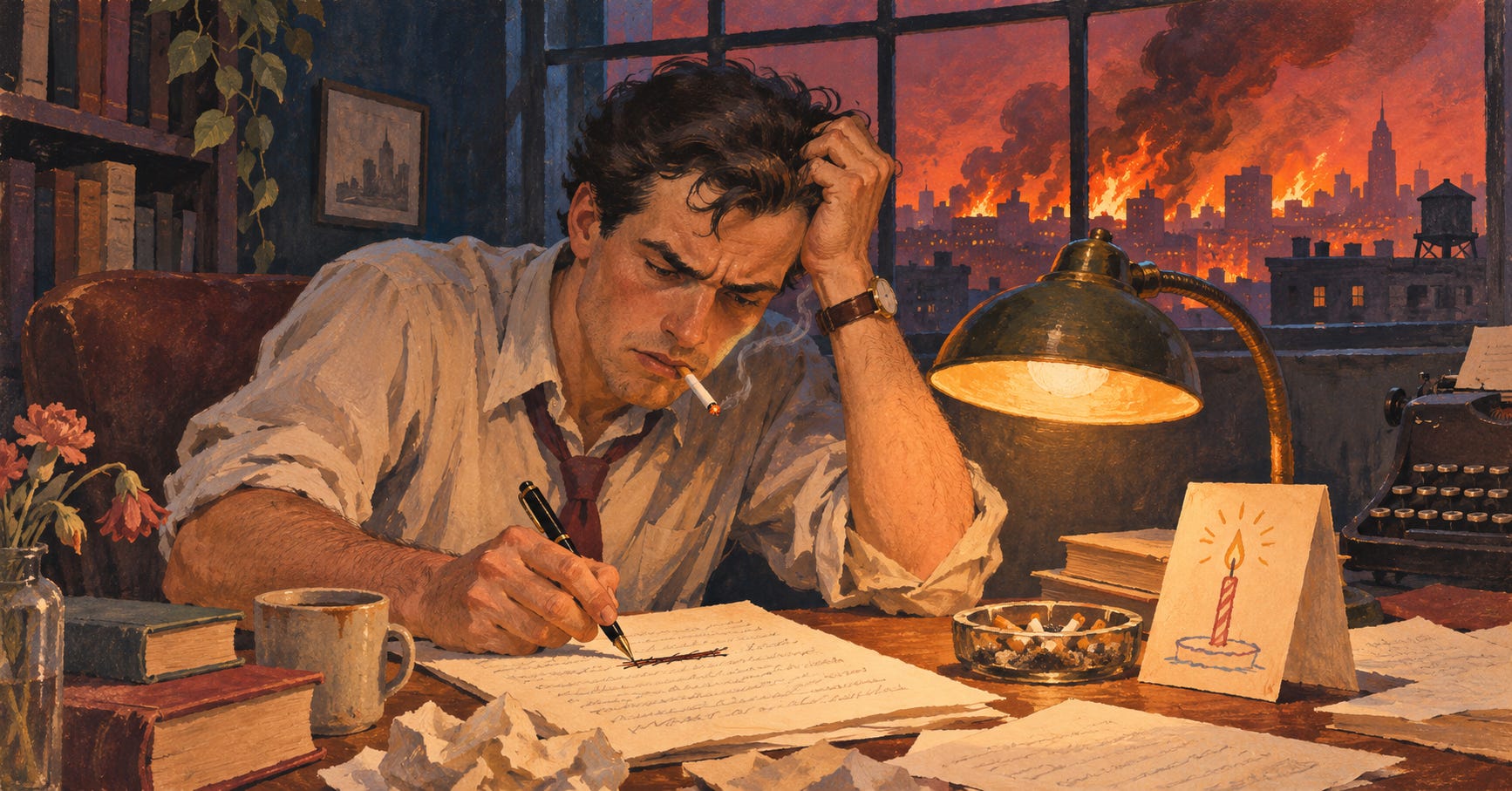
What I’m saying is Johnny Cash’s Man in Black is a weenie. Solidarity, in the long run, means more birthday parties than burials. God gave me life and I’m going to use it to grow, to shine, to question and to dream — a time for every thing in its season, to be sure, but still room for Christmas in winter, and the occasional funeral in summer.
Beside this E.B. White describes the essayist and his gist perfectly, I think:
The essayist is a self-liberated man, sustained by the childish belief that everything he thinks about, everything that happens to him, is of general interest. He is a fellow who thoroughly enjoys his work, just as people who take bird walks enjoy theirs. Each new excursion of the essayist, each new “attempt,” differs from the last and takes him into new country. This delights him. Only a person who is congenitally self-centered has the effrontery and the stamina to write essays. There are as many kinds of essays as there are human attitudes or poses, as many essay flavors as there are Howard Johnson ice creams. The essayist arises in the morning and, if he has work to do, selects his garb from an unusually extensive wardrobe: he can pull on any sort of shirt, be any sort of person, according to his mood or his subject matter—philosopher, scold, jester, raconteur, confidant, pundit, devil’s advocate, enthusiast.
In short, my life is so much bigger than the news — so I’ll keep writing whatever the hell I feel like.
Yours,
-J
November 16th, 2026
From The Devil’s Dictionary:
ACCIDENT, n. An inevitable occurrence due to the action of immutable natural laws.
Nicely authored. I especially liked the Burke and White references.
We seem to be on the same page sometimes.
https://rickswenson2.substack.com/p/what-will-you-leave-when-you-leave