

Dear T,
I really, deeply, truly believe that somewhere around one third of the country, under psychiatric scrutiny, could be classified as clinically insane. I also believe that around 100% of Americans would agree with this statement, even though 0% of them would volunteer themselves for the loony bin. So before you start clapping, please see whether you're on the list.
I would include here people who think the earth is flat and roundness is “a conspiracy,” who believe that blowhards like Pat Robertson and Robert Morris speak for God; who think men can turn into women, and that anyone who disagrees in public should be subject to penalties. I would add anyone who thinks Charlie Kirk was murdered by TPUSA so that Erica Kirk and JD Vance could have an affair; and anyone who thinks Jewish people are God's favorites, incapable of pissing Him off, and that silencing all their critics is the main way to prove you’re on “the right side of history.”
Next is anyone who thinks The Sermon on the Mount should be on courthouses instead of the Ten Commandments, and that doing so would not only be “more Christian,” but less dangerous to the public health than anarchy, or communism. And why stop there? I'd add people who put criminal aliens in the same category as Anne Frank, and think Elon Musk, the Jew-loving libertarian, is a Nazi, and Donald Trump is “literally Hitler.”
These not-entirely uncommon positions go well beyond plain ignorance and rank up there with hearing voices and seeing gremlins; and if I had the choice, I'd strip them of the vote and even put some of them in psych wards. This would clean up the country significantly, and let us get back to discussing matters more serious than whether Somalis are more American than Republicans, and whether Emmanuel Macron’s wife is actually a dude.
Or at least it would, if it wasn’t for the second third of Americans who are just stupid. Republicans like to call these people “Democrats”* and Democrats like to call these people “Republicans,” but the reality is these people are what everyone usually refers to as “swing voters.” These are people who overwhelmingly agree that an open border is bad; and then, when you try to send people back across the border, The Pew Research Center says they can’t stand that either.
These are people who hate inflation, so they vote for the guy who wants tariffs. They want to bring manufacturing back to America, but they want it without starting inflationary trade wars. They’re worried about the national budget, but they hate it when you cut spending. They can’t stand rioters running loose, and cry when you send the national guard to stop them.
In short, the swing voter is somebody who can’t see pros and cons. He has probably never heard of pros and cons. He doesn't know what “a tradeoff” is, and every time he votes, he thinks he elected a savior, only to find out, four years later, that the hero he elected is actually (to him these days) a villain. He has no intelligible philosophy, no workable ethic, no cohesive system of law other than “this hurts and I hate it and now I want the other thing.” Thus whoever’s in charge is on the news. And to him, whoever's in the news becomes the national bogeyman. He runs one way and stubs his toe. He turns the other way, and falls off a cliff.
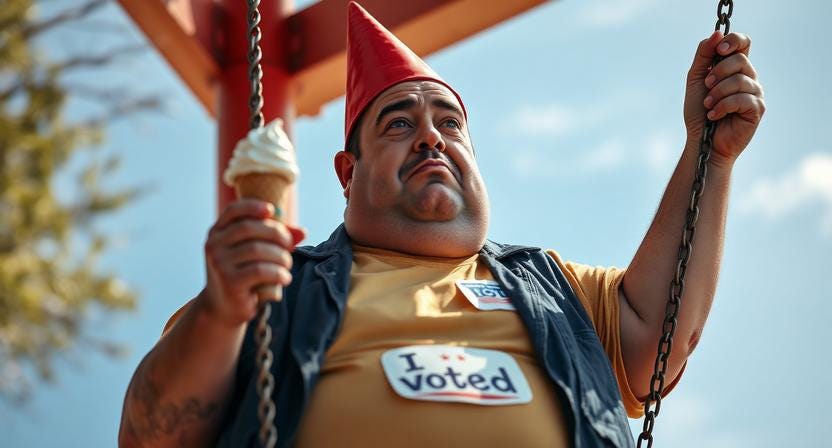
Is he completely without merit? Not entirely, I would argue. The great virtue of the swing voter is his humility: the ability to say “I was wrong” and change course. The big problem with swing voters is they’re always wrong. And to prove this, I refer you to their own opinions — enshrined and totally contradicted, ad nauseam, in what they refer to as “their voting record.”
This is, of course, when humility goes wrong. When humility goes right, it means people who are not only open to new information, but who reevaluate their positions in the light of new evidence and questioning. And that means they believe in asking questions and being questioned. They consider it a right, even — a public service. They call it “freedom of speech,” and know “free speech” doesn't mean joining Al Qaeda and making pornography.
The real qualification to not being a psycho or a dumbass means not having a giant ego. It means recognizing your vulnerability to short-sightedness, ignorance, laziness, prejudice and provincialism, half-baked faiths, blind spots, ego trips, and sacred cows. And that’s the irony of being self-aware. This last remaining hope, not just of American civilization, but of any civilization, is the only portion of the public which doesn’t fully believe in itself.
When this goes right, a man becomes a beacon of light — standing tall and bright in the middle of a hurricane. When he changes his position he merely adds to it, refining it, correcting its course. And as he grows so does his sense of balance, and grace, and nuance**. But when humility goes wrong, he flip-flops from one extreme to the next and becomes the hurricane itself — and gets referred to in the news as a swing voter.
Yours,
-J
P.S. I suspect that many of the things we blame on faulty brains may be a result of their working too well.
For instance, the belief that Donald Trump, on the verge of arrest after the 2020 elections, was playing 4D chess, and that random clerks and garbagemen were privy to a host of insider information, and we should go to Washington DC and “trust the plan,” was probably a front for extreme feelings of powerlessness and ignorance — a desperate reach not only for hope, but for the dream that we, the puny and the clueless, could actually understand the world around us. And that somebody smart was actually in control of it.
White Savior Complex ranks even crazier than this, in my book: a desperate need to not only love and care for somebody (we see this most often with childless ladies and rejects) but to feel loved and needed yourself. Thus the desperate round-the-world search not only for somebody to stand above and pity, but the half-psychotic quest for an enemy — an enemy whose crimes you fabricate, against all evidence, and the “victim” whose flaws you deny, to the point of obliviousness. “Trust the plan” was the crazy belief in somebody else. “Black Lives Matter” was the crazy belief in yourself. Especially when you yourself were actually the one in need of help.
The really big question here isn’t whether these people are crazy, though. I think it’s pretty clear that people with real needs and working brains are capable of believing and doing worse things than lunatics. The real question is, am I lying to myself in some way like they are? And if I am, am I brave enough to see it?
*On top of the fact that I believe one third of Americans are bonkers, I really, truly, and unsarcastically feel that there are smart Democrats out there. And like all smart people, these are defined most by the questions they ask.
For instance,
Is it okay for the President to deport illegal aliens, who came from Mexico, to war-torn Sudan? Or to put them in a Salvadoran prison without a trial?
Do non-citizen immigrants like Mahmoud Khalil have a right to free speech? Or does the Bill of Rights only apply to citizens? Can foreigners be detained indefinitely by ICE?
Or, why is the President pardoning a bunch of ponzi-schemers and granny-scammers?
Is it a good precedent to send troops into the Capitol? Wasn’t that the beginning of the end for Rome?
Why is Trump saying the Epstein files are fake after campaigning on their release? Wasn't he aware of them during his first term? And why did Congress have to force him to release them? And how do we know the redacted names aren’t public officials?
Should the President, the plaintiff in a lawsuit he filed before taking office, be able to decide whether he gets paid 230 million dollars — of taxpayer money?
Is it morally wrong to question our relationship with Israel? Is criticizing things Jews currently do really the same thing as anti-Semitism?
Didn’t Trump campaign on reducing inflation — not making it worse?
How can we get rid of income taxes? If tariffs are to bring jobs home, how can that be a stable tax revenue once we don’t import nearly as much?
How can Trump pay $2000 to each American from the tariff revenue if the tariff revenue is way less than the payout?
Isn’t spending this recklessly dangerous for the country? (To be fair, neither party really cares about this).
Is our beef with Venezuela really about drugs when most of our citizens are killed by drugs from Mexico?
These to me are all useful and legitimate questions, and, quite frankly, I think Republicans who don’t ask them are silly. And I wish the people who asked these kinds of questions were in charge of the Democrats. But we all know they aren’t. And instead of such respectable pests, we’re left with the people who ask whether it’s okay to have a border, whether cops should be allowed to shoot back at criminals, and whether anyone can define “a woman.”
**How important is nuance? Nietzsche writes, in Beyond Good and Evil,
In our youthful years we respect and despise without that art of nuance which constitutes the best thing we gain from life, and, as is only fair, we have to pay dearly for having assailed men and things with Yes and No in such a fashion. Everything is so regulated that the worst of all tastes, the taste for the unconditional, is cruelly misused and made a fool of until a man learns to introduce a little art into his feelings and even to venture trying the artificial: as genuine artists of life do. The anger and reverence characteristic of youth seem to allow themselves no peace until they have falsified men and things in such a way that they can vent themselves on them – youth as such is something that falsifies and deceives.
Later, when the youthful soul, tormented by disappointments, finally turns suspiciously on itself, still hot and savage even in its suspicion and pangs of conscience: how angry it is with itself now, how it impatiently rends itself, how it takes revenge for its long self-delusion, as if it had blinded itself deliberately! During this transition one punishes oneself by distrusting one’s feelings; one tortures one’s enthusiasm with doubts, indeed one feels that even a good conscience is a danger, as though a good conscience were a screening of oneself and a sign that one’s subtler honesty had grown weary; and above all one takes sides, takes sides on principle, against ‘youth’. – A decade later: and one grasps that all this too – was still youth!