

Dear S,
Wyatt Mason says, in his introduction to the complete works of Arthur Rimbaud, that there are two theories on the art of translation, and picking the wrong one at the wrong time can get somebody killed.
The first camp says you can be too loose. This camp believes that if somebody wrote something magical, messing with it too much means you commit slander. Nabokov put it best, I think:
What is translation? On a platter
A poet’s pale and glaring head,
A parrot’s screech, a monkey’s chatter,
And profanation of the dead.
Or as my own Swahili translation goes,
Who is a translator? In a bowl
A bald writer winks
And says “The N Word” like a parrot at the pet store
An affront to Martin Luther King Jr.
Some people take these offenses so seriously that they won’t let you translate something at all. This was at one point the position of the Catholic Church: partly because they had immense respect for God’s original speeches to Moses in Latin, partly because they were worried people would find out what God actually said about idol worship and rich people and Pharisees. But mostly because they had an immense disrespect for the intelligence of their constituents. Unfortunately they lost, and now we have to deal with Aunt Linda’s interpretation of “I can do all things through Christ who strengthens me.” A doctrine she refuses to prove, to this day, by doing a backflip.
So far as I can tell, nobody paid worse for the “anti-translation” stance than William Tyndale, who translated the Bible into quality English, was condemned by trial, and promptly strangled and burned by a hangman. In the hangman’s defense, though, how else are you supposed to treat the word of God? Surely God is a master of communication, isn’t He? And surely, if this is the case, every syllable was arranged to perfection? Confusion between eros and philia and agape, a missing modifier here or there, and you're not just dealing with a degradation of majesty. Suddenly you’ve got things like “the love of money is the root of all evil” — an objectively stupid saying which destroys the Bible’s credibility to the intelligent, and lends credibility, if you’re a dumbass, to failures, layabouts, and communists.
On the other hand, go too strict and you also lose meaning. An unpalatable syntax, a few foreign and outdated phrases, and suddenly God sounds like a dork or a fossil — and nobody wants to read Him. Or worse, the uptight start trying to talk like Him*. Sometimes translators forget that when the prophets spoke they were speaking to specific people (with specific cultures) naturally, beautifully, and poignantly; conveying an idea not just in the symbols we know as words, but in the arrangement of the words themselves. And it's not an easy thing to bottle the lightning.
A good translation has to be somewhere in between. There's a sense in which too much license becomes libel, of course; but there's also a point where too much fidelity becomes infidelity. And if we don’t make translation a work of art in itself — an attempt to get the vibe, the gist, the beauty and the emphasis of the original into another language — then I would argue we’ve missed the point of translating.
Language is about way more than facts. It's about tone and imagery and implications and cultural associations and virtue signaling — conveying a meaning not just by what you say, but usually by how you say it. Thus there's no way to completely replicate any brilliant, nuanced work of art from one language to another. The translation itself is a new work of art — and if the translation fails to capture either the message or the magic, then I would argue the translator is a failure. (I would still stop short, in most cases, from strangling and burning him).
This being said, I have no idea what to make of Coleman Barks’ translation of Rumi. Not just because I can’t really compare it with 12th century Persian, but because of passages like this:
Some word combinations, like skin-and-bone arrangements, have sublime qualities.
These three people talking in the street are ordinary young men,
but Alif, Lam, and Mim have an exchange more like Larry, Curly, and Moe.
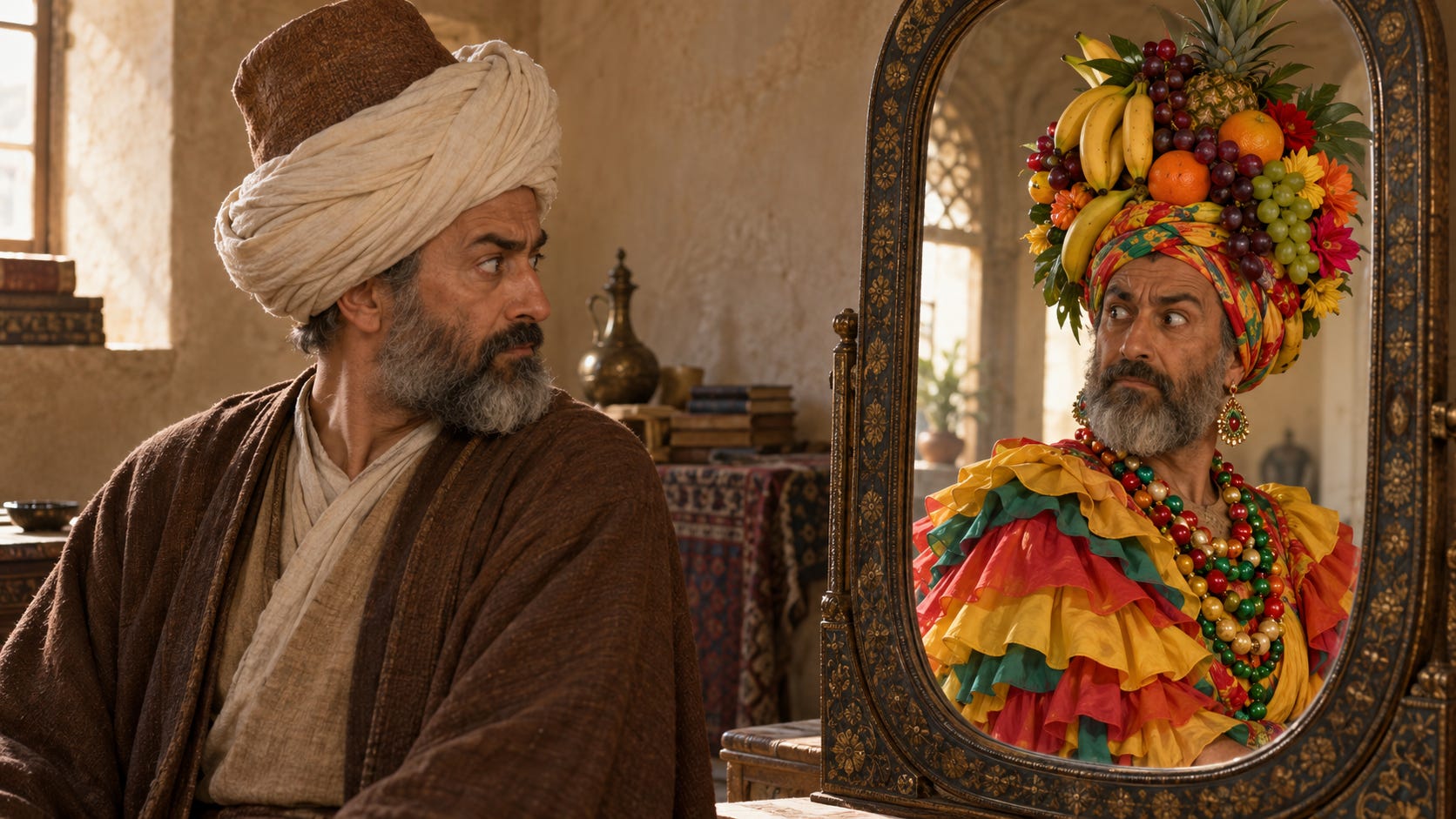
This isn't just a sharp commentary on how delivery says more than you intend. In a situation like this, how was Coleman Barks to deliver? You need the names of three easily recognizable boobs and none of them quite translate. So you make something up that an American will understand, and immediately ruin good faith in your whole project. Is this the right thing to do? Or is it a mistake? Do you take the bullet? Or do you let Rumi take it for you?
I would argue that getting deep into the book makes the whole question irrelevant. There is so much magic scattered haphazardly between TikTok girl-bossery and total gibberish that you almost don’t care.
Consider this musing on a man passing into the nothing:
A candle is made to become entirely flame.
In that annihilating moment it has no shadow.
It is nothing but a tongue of light describing a refuge.
Look at this just-finishing candle stub as someone who is finally safe from virtue and vice, the pride and the shame we claim from those.
At that point I don’t really care whether it’s accurate or not. What Barks captured here is something vivid and deep and true — and almost impossible to put into words. In other words, real poetry**. Rumi shines bright when he talks about dying, in passages like:
Be quiet and clear now like the final touchpoints of calligraphy.
Your name has been erased from the roaring volume of speech.
You can almost hear the quill lifting gently off the paper, and the trail of ink thinning into oblivion — a fine metaphor for a man passing away if there ever was one.
And what about this?
Every object, every being, is a jar full of delight. Be a connoisseur, and taste with caution.
— a reminder that the world is more dangerous because of beauty, not because of ugliness; and that your happiness depends on whether you choose to see it, when you taste it, and how you touch it. Almost like going to the grocer or the hardware store. And I like this passage, about how it feels when you’re overwhelmed with an existence too beautiful for words.
Excuse my wandering. How can one be orderly with this?
It’s like counting leaves in a garden, along with the song-notes of partridges, and crows.
Sometimes organization and computation become absurd.
Did Rumi say it better? Maybe he did; but the ancient germ remains whole and palatable — like the honey we found in the tomb of Tutankhamen.
Because Rumi wrote in a state of ecstasy, many of his poems are half-lucid, half-dreamy — the ramblings of a man who can’t stand still and doesn’t quite know where to move.
Lo, I am with you always means when you look for God,
God is in the look of your eyes, in the thought of looking,
nearer to you than your self, or things that have happened to you.
There’s no need to go outside.
Be melting snow. Wash yourself of yourself.
Which really captures the essence of being “a mystic.” Many of us glide through life chasing things, planning things, wanting things, dreading things — separating and pretending things. The mystic is caught up in the wonder of being things. To the common man, life is mundane: a task, a checklist. The mystic frames his entire consciousness, when possible, in the ecstasy of being and communion, and the result is like putting a plug into a socket.
Once you recognize that God running the universe also means he's running you, you begin to wonder things. Such as where the line between you and Him is drawn, and how little you actually control: not just of the universe, but of your own life — and you begin learning to go with it.
Do you think I know what I’m doing? That for one breath or half-breath I belong to myself? As much as a pen knows what it’s writing, or the ball can guess where it’s going next.
And there's the joy of losing yourself in this process: a letting go of pride and ego, receiving thankfully what God has given you, and floating gently down the stream:
Try and be a sheet of paper with nothing on it. Be a spot of ground where nothing is growing, where something might be planted, a seed, possibly, from the Absolute.
— a reminder that sometimes we can't receive things because we’re so busy with our own plans that we accidentally refuse them.
Solomon says delight yourself in the Lord, and He will give you the desires of your heart. Rumi echoes this in a different way, noting that chasing the divine always leaves you tasting — but never full, and never bored.
Every thirst gets satisfied except that of these fish, the mystics, who swim a vast ocean of grace still somehow longing for it!
And the world around us is full of meaning and design and soul if we look for it — an I, Pencil in a single sentence:
The beauty of careful sewing on a shirt is the patience it contains.
And this description of the sunny days and storms of the soul, and how we are a reflection of the divine as much as the universe around us:
We weep God’s rain. We laugh God’s lightning.
Rumi, so far from sitting on wealth like a miser, reminds us that the pleasure of wanting and loving lies as much in the longing as in the having.
A lover’s food is the love of bread, not the bread. No one who really loves, loves existence. Lovers have nothing to do with existence. They collect the interest without the capital.
What I love about Rumi is his insistence that every man is a universe so large it will never be discovered by anyone else but God.
Every spoken word is a covering for the inner self. A little curtain-flick no wider than a slice of roast meat can reveal hundreds of exploding suns. Even if what is being said is trivial and wrong, the listener hears the source. One breeze comes from across a garden. Another from across the ash-heap. Think how different the voices of the fox and the lion, and what they tell you!
We catch glimpses of men — vivid and revealing, but never the men in themselves. Rumi sees this because he doesn’t count the riches of the universe with a telescope: he counts the cells with a microscope and multiplies his riches exponentially. And to those who value the hoarding of book-wisdom so much they forget it's for living:
Today, like every other day, we wake up empty and frightened. Don’t open the door to the study and begin reading. Take down a musical instrument. Let the beauty we love be what we do.
And what about this passage, about the tunnel-vision of true lovers?
Come to the orchard in Spring. There is light and wine, and sweethearts in the pomegranate flowers. If you do not come, these do not matter. If you do come, these do not matter.
and that in the matter of relationships, 1 + 1 = 3:
Your associations bear progeny. Be careful, therefore. Wait, and be conscious, before you go to meet anyone. Remember there are children to consider!
Children you must live with and tend to, born of your emotions with another, entities with a form, and speech, and a place to live. They are crying to you even now. You have forgotten us. Come back. Be aware of this. A man and a woman together always have a spiritual result.
Speaking of which, there’s a section featuring a fight between a man and his wife, and barbs are thrown that are more likely to hit the reader harder than the spouses:
You’re not as satisfied as you pretend! You’re the snake and the snake charmer at the same time, but you don’t know it.
and
You were young once, and content. Now you think about money all the time. You used to be that money. You were a healthy vine. Now you’re a rotten fruit. You ought to be growing sweeter and sweeter, but you’ve gone bad.
And even this random musing on taking a hot bath:
Steam fills the bath, and frozen figures on the wall open their eyes, wet and round, Narcissus eyes that see enormous distances, and new ears that love the details of any story. The figures dance like friends diving and coming up and diving again.
— a portrait of steam collecting on the wall that’s hundreds of years old and feels so immediate, so alive.
The Essential Rumi and The Soul of Rumi are so full of quotes like these, little flashes of light mixed in pages of nonsense, that I’m never really sure whether to give him my full recommendation. But I can say I approve of these passages, and whether or not Coleman Barks was true to Rumi, or whether it was possible to be really true to Rumi, or if it was even desirable to be true to Rumi, is up for debate — because I don’t really know Rumi. But I can see Rumi through the lens of Coleman Barks, and I thank God: for now that seems to be enough.
Yours,
-J
October 12th, 2026
*In a parody magazine, I once heard an American fundamentalist say If the King James Bible was good enough for the apostles, it’s good enough for me.
**What is poetry, anyway? H.L. Mencken writes, in his Chrestomathy:
Poetry can never be concocted by any purely intellectual process. It has nothing to do with the intellect: it is, in fact, a violent and irreconcilable enemy to the intellect. Its purpose is not to establish facts, but to evade and deny them. What it essays to do is to make life more bearable in an intolerable world by concealing and obliterating all the harsher realities. Its message is that all will be well tomorrow, or, at the latest, next Tuesday; that the grave is not cold and damp but steamheated and lined with roses; that a girl is not a viviparous mammal, full of pathogenic organisms and enlightened self-interest, but an angel with bobbed wings and a heart of gold. Take this denial of the bald and dreadful facts out of poetry—make it scientific and sensible—and it simply ceases to be what it pretends to be. It may remain good prose; it may even remain beautiful prose. But it cannot stir the blood as true poetry does; it cannot offer that soothing consolation, that escape from reality, that sovereign balm for every spiritual itch and twinge which is the great gift of poetry to man.
But this is only half true. Rumi — or maybe Barks — comes closer to the meaning and purpose of poetry when he says,
The breeze at dawn has secrets to tell you.
Don’t go back to sleep. You must ask for what you really want.
Don’t go back to sleep.
People are going back and forth across the doorsill where the two worlds touch.
The door is round and open. Don’t go back to sleep.
“Where the two worlds touch” is something instantly recognizable to anyone who dreams: the lights flickering in the halls of consciousness and fantasy, each preparing to receive us into the other. And that’s where we find the real meaning of poetry. It is the putting of ideas into pictures, of fusing truth with a feeling, a sight, a sound, a scene — not merely stating truth, but giving it color. Not merely painting with color, but filling it with truth. And the irony is that, like we have to go insane every night in our dreams to stay sane when we’re awake, the true poet makes us understand what we know with our minds by connecting it with something we felt with our senses. He thus stands with one foot on the concrete and the other on the clouds — straddling two dimensions to make us feel complete.
What does real poetry look like, then? Aside from real giants like David, Solomon and Shakespeare, consider these lines from Tennyson’s In Memoriam:
Be near me when my light is low,
When the blood creeps, and the nerves prick
And tingle; and the heart is sick,
And all the wheels of Being slow.
Be near me when the sensuous frame
Is racked with pangs that conquer trust;
And Time, a maniac scattering dust,
And Life, a Fury slinging flame.
Be near me when my faith is dry,
And men the flies of latter spring,
That lay their eggs, and sting and sing
And weave their petty cells and die.
Be near me when I fade away,
To point the term of human strife,
And on the low dark verge of life
The twilight of eternal day.
And this, dear S, is poetry.