

Dear L,
Baby names have always been a matter of difficulty. If you name him something that sounds great when he’s a baby it usually looks bad on him as a man. If you name him something great for a man, it probably fits badly when he’s a baby*.
No baby ever looked right as a Hunter or a Justice or a Steve. And likewise no man ever looked strong as a Percy or a Timmy or a Bud. Aim too cute and the man looks like a coward or a tard. Aim too high and the kid looks like a prick or a fraud.
Why bring this up? Because in the entirety of history, nobody’s parents ever aimed higher than Saint Jerome’s. His real name was Eusebius Hieronymus Sophronius — or, The Devout and Holy-named Sage. When he was young it didn't fit him because he was too young to be wise or holy. When he was old it didn't fit him because he was a jerk.
He was born sometime around 340 and given an at-the-time world-class education in the classics. And his whole life he was so hot-headed for Christianity and believed so much in perfection that his own bishop told him to calm down. You've got to be patient with people, the bishop said. They’re just people.
Jerome disagreed. He called the bishop a rotten, ignorant brute and a good match for a bad flock; gathered up a few of his closest friends, and went off into the desert to starve two of them to death.
Jerome almost died himself from the “sinless” (read: homeless and bathless and foodless) lifestyle and the unhealthy climate, but he decided to press on. He left to another hermitage with his library in tow — Virgil and Cicero and other favorites — and became worried he loved them more than the Bible. It was then he had a dream, the account of which goes as follows.
[I was] dragged before the Judge’s judgment seat. I was asked to state my condition, and replied that I was a Christian. But He Who presided said, “Thou liest; thou art a Ciceronian, not a Christian. For where thy treasure is, there will thy heart be also.”
Straightway I became dumb, and I felt the strokes of the whip — for He had ordered me to be scourged. [...] At last the bystanders fell at the knees of Him Who presided, and prayed Him to pardon my youth and give me opportunity to repent of my error, on the understanding that the extreme of torture should be inflicted upon me if ever I read again the books of Gentile authors. […] This experience was no sweet or idle dream. [...] I profess that my shoulders were black and blue, and that I felt the bruises long after I awoke. […] Henceforth I read the books of God with greater zeal than I had ever given before to the books of men.
Proof that even in the Dark Ages, the only way to make Leviticus interesting is to threaten somebody with torture.
People swallowed his story, though, and in 379 the people of Antioch made him a priest. He was so smart and radical and sharp that by 382 he was in Rome — a secretary to Pope Damasus, who commissioned him to translate the New Testament into Latin. Despite being surrounded by luxury he ate sparsely, and kept the brown robe of an anchorite monk. He became really popular among the rich ladies, to the point where pagan critics started to raise eyebrows and make jokes about it.
An unfair accusation, I think, because Saint Jerome hated sex more than anyone else. He condemned priests for getting married. He advised women to run off to convents. And because Saint John was unmarried, he preferred him over Saint Peter. “I praise marriage,” he said — “but only because it makes more virgins.”
In a letter to a girl named Eustochium, he comes close to sounding like a feminist, or even a man-hating lesbian. He says he’s not against marriage, per se, but that if you stay single you avoid the pains of pregnancy, crying children, taking care of a household, and the tortures of jealousy — a narrow escape from Sodom itself, as he puts it. He writes,
Virginity can be lost even by a thought. […] Let your companions be those who are pale of face and thin with fasting. […] Let your fasts be of daily occurrence. Wash your bed and water your couch nightly with tears. [...] Let the seclusion of your own chamber ever guard you; ever let the Bridegroom sport with you within. […] When sleep falls upon you He will come behind the wall, and will put His hand through the door and will touch your womb. And you will awake and rise up and cry, “I am sick with love.” And you will hear Him answer: “A garden enclosed is my sister, my spouse; a spring shut up, a fountain sealed.”
— a letter which went public, made everybody throw up, and was greeted (in his words) “with showers of stones.” Proving that across all cultures and ages, “Jesus is my boyfriend” lyrics are gross.
A rich lady named Paula — Eustochium’s mom, it turns out — fell for this tomfoolery and brought her daughters along with her. Three months after doing Jerome's diets in a convent, one daughter, Blaesilla, got too sick to hold her own head up, and promptly died. The public was furious, and the pagans (as Jerome says in his letters) wanted to throw him into the river.
Jerome felt less enthusiastic about it. When Paula, Blesilla’s mother, couldn't eat food, and was seen crying at the funeral hysterically, Jerome wrote her a very impressive letter telling her to man up.
Have you no fear, then, lest the Saviour may say to you: Are you angry, Paula, that your daughter has become my daughter? Are you vexed at my decree, and do you, with rebellious tears, grudge me the possession of Blæsilla? [Note that Jerome is speaking for Jesus here] You ought to know what my purpose is both for you and for yours. You deny yourself food, not to fast but to gratify your grief; and such abstinence is displeasing to me. Such fasts are my enemies. I receive no soul which forsakes the body against my will. [...] My spirit rests only upon him that is poor and of a contrite spirit, and that trembles at my word.
Having thus outdone Jesus, who cried when Lazarus died, he ended the letter on a softer note:
[S]o long as breath animates my body, so long as I continue in the enjoyment of life, I engage, declare, and promise that Blæsilla’s name shall be forever on my tongue, that my labors shall be dedicated to her honor, and that my talents shall be devoted to her praise. No page will I write in which Blæsilla’s name shall not occur.
A beautiful tribute — except I bought a giant collection of Jerome’s letters, and Blaesilla’s name only shows up in seven of them.
Having pissed off enough people in Rome, Jerome high-tailed it to Bethlehem. It was there he took Paula and her other daughter Eustochium, and proceeded to live a life of diabolical virtue. Sequestered in a cave with his books, he spent the next 34 years of his life reading the classics the angel told him not to, writing the Latin Vulgate, and fighting with the other church fathers. He called the majestic St Ambrose** “a deformed little crow.” He quarreled sharply with both Chrysostom and Augustine. He called John, the patriarch of Jerusalem, a Judas and a Satan — “for whom Hell can never provide adequate punishment.” Christ said to the Apostles, “they will know you’re mine by the love you show for one another.” If this is the case, we have yet to know who St Jerome belongs to.
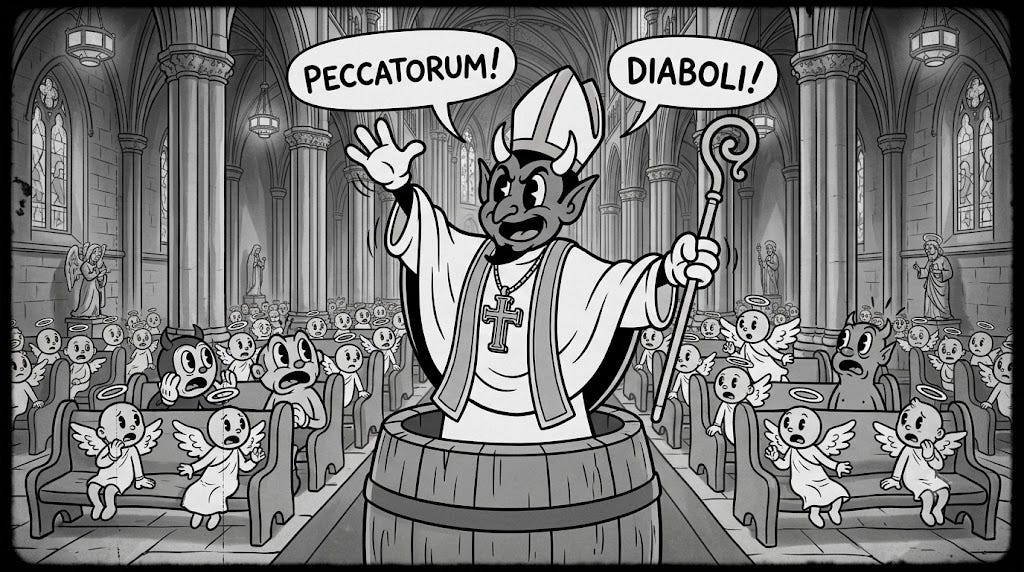
He was never officially confirmed a saint by the Catholic Church — a testament to the good sense of the Vatican. He earned the title by public acclaim after writing The Latin Vulgate — no small gift to mankind, as it made the Bible accessible to Europe — and his fifty-something works defending the church against “heretics.” Aside from this he set up a hospice for pilgrims in the Holy Land, and a school to teach children a variety of subjects.
These things being said, his personal letters show little-to-none of the Fruit of the Spirit. Instead we see pride, insolence, reckless tale-bearing, outright hatred, Scripture-twisting, and a lack of grace almost unparalleled in Patristic literature. Saint Jerome is what happens when you cross the arrogance of a Cicero with the intolerance of an Imam and the ignorance of a Southern Baptist.
May the grace of God be with him — and also with me, a man who either has the opposite flaws of Saint Jerome, or for every apparent mote, a log.
Yours,
-J
July 6th, 2026
P.S. Why is Jerome such a pain in the ass? Why is he against good clothes, and food, and houses, and mourning, and sex? And probably more importantly, why did so many Christians find this inspiring?
The problem with the New Testament is that, if some passages are taken at face value, sometimes it feels morally, intellectually, and emotionally stifling. "The cares of this world" are seen as an obstacle to salvation (Matthew 13:18-23). How long would it be before somebody tried to throw them away? Suffering is seen as a badge of belonging (2 Timothy 3:12; 1 Peter 2:20-21). How long would it take for happiness to be considered a sign of perdition? In order to follow Jesus you have to “pick up your cross,” feeling lust for a neighbor is adultery, and hatred for any fellow man is murder. How long would it be for someone to confuse losing with winning — to cut off his balls like Origen, to try and mollycoddle a public enemy? The fact that St Jerome tried to do much of this and still live is impressive. The fact the he didn't know it’s impossible (and that expecting everyone else to do it is cruel) is more than just prideful. It’s Satanic. Nobody can love anyone else (or commit an act of charity) without wanting them to “do well.” And conversely, nobody can hate anyone else without wanting them to hit rock bottom like Saint Jerome.
The Old Testament on the other hand is liberating. The Psalms give you a license to feel — to curse, and yowl, and cry, and laugh. Lamentations gives you a license to mourn. The Song of Solomon gives you a license to lust. The Proverbs give you a license to think — to judge, and to get rich. Ecclesiastes gives you a license to doubt and question and despair. The Law gives you a right to have rights. By the New Testament almost all of this is either forbidden or in limbo; and “the saints” fight what they think is a war against sin nature, only to find themselves in a war against nature. It is technically impossible to be “a good Christian” and be a full person. Christianity touts the so-called “humane” virtues so hard that sometimes it becomes cruel to humanity.
Thus I thank God most of Christendom is half-assed. We have yet to see whether being human makes us frail or being frail makes us humane. Either way, the road to moral perfection has only two outcomes — one ending up like God, and the other ending up like St Jerome. And I think Jerome makes it clear that the “God outcome” is well beyond our ability. The end of the attempt is never loving. The byproduct of forcing the impossible is always loathing.
Do you want to be a good Christian? Be gracious and humble — examine yourself, beg for forgiveness, and then, if you’re trying to earn your salvation, give up.
*The ideal names for a boy are versatile — such as William, or Thomas. Baby Billy is a sure win. So is William for a politician or a professional, and Will or Bill for a strong man in general. And Thomas can fit a scholar well, or a doctor or a writer, as Tommy can fit a bike-riding scoundrel or a bare-knuckle boxer. A good name should be full and smart-sounding — easy to whittle down for pet names and parties; easy to puff back up when writing a resume.
**Of course St Jerome quarreled with St Ambrose. St Ambrose was a peacemaker and a statesman and that made them natural enemies. Will Durant, whose writings informed much of the essay above, writes in The Age of Faith,
The career of Ambrose (340?–398) illustrates the power of Christianity to draw into its service first-rate men who, a generation earlier, would have served the state. Born at Trier, son of the prefect of Gaul, he was by every precedent destined to a political career, and we are not surprised to hear of him next as provincial governor of northern Italy. Residing at Milan, he was in close touch with the emperor of the West, who found in him the old Roman qualities of solid judgment, executive ability, and quiet courage. Learning that rival factions were gathering at the cathedral to choose a bishop [PERSONAL NOTE: these “gatherings” of rival Christians were known to end in riots and murder], he hurried to the scene, and by his presence and his words quelled an incipient disturbance. When the factions could not agree on a candidate, someone suggested Ambrose; his name brought the people to an enthusiastic unanimity; and the governor, protesting and still unbaptized, was hurriedly christened, ordained to the diaconate, then to the priesthood, then to the episcopacy, all in one week (374).
He filled his new office with the dignity and mastery of a statesman. He abandoned the trappings of political position, and lived in exemplary simplicity. He gave his money and property to the poor, and sold the consecrated plate of his church to ransom captives of war. He was a theologian who powerfully defended the Nicene Creed, an orator whose sermons helped to convert Augustine, a poet who composed some of the Church’s earliest and noblest hymns, a judge whose learning and integrity shamed the corruption of secular courts, a diplomat entrusted with difficult missions by both Church and state, a good disciplinarian who upheld but overshadowed the pope, an ecclesiastic who brought the great Theodosius to penance, and dominated the policies of Valentinian III.
Little surprise that such a kindly, capable, and ultimately worldly saint would end up fighting with a blowhard, an ascetic, and a literary viper. One was made for building the world up. The other was made for tearing it down.